A custom built-in entertainment center gives the TV wall a finished look and a place for everything the screen needs. If you are weighing custom cabinetry and built-ins for your home, this guide covers what goes into the wall, how older rooms are handled, what moves the price and how the work runs from drawing to install.
Key Takeaways
- Decide how much wall the piece should cover first: a single low cabinet and a full floor-to-ceiling wall are both built-ins.
- Settle on the exact TV and every component before design begins, because the cabinetry is sized around that equipment.
- Uneven plaster or a sloping floor in an older room is no reason to skip a built-in; a custom piece is cut to fit it.
- Choose between stain and paint before the wood species, since paint hides the grain that a stained finish puts on show.
What a built-in media wall can include
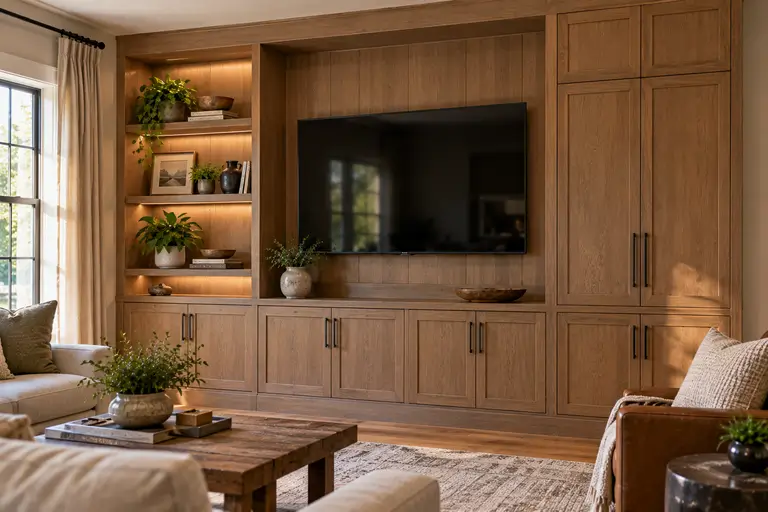
A built-in media wall can be one low cabinet under the TV, or millwork that runs floor to ceiling and wall to wall. These are the pieces you can combine:
- TV bay: a recessed panel or open bay sized to the screen, so the set sits in line with the cabinetry around it.
- Base cabinets: closed storage for the receiver and game consoles, behind doors or drawers.
- Flanking towers: tall units on each side, with open shelves for display or doors that hide clutter.
- Paneling: custom paneling or a mixed media wall treatment that carries the design across the whole wall, so the built-in reads as architecture rather than furniture.
Where the wall holds a fireplace, the cabinetry is drawn around the mantel and fireplace surround so both read as one piece. Keep the wood cabinetry and trim back from the firebox opening by the clearances the building code and the fireplace or insert maker require, and confirm them with your local building inspector before the drawings are approved.
Nationally, homeowners spend $3,000 on average on a set of built-in cabinets, according to inchcalculator.com’s built-in cabinet cost guide. How many of these pieces your wall includes moves that number, and a quote on your own wall is how you learn your price.
How do you plan a built-in around the TV, cables and equipment ventilation?
Plan it from the equipment outward. The screen and the gear that feeds it set the dimensions, and the cabinetry is drawn around them, so measure the TV you own (or the one you plan to buy) before anything is drawn.
- TV: set the mount height from where you sit, so you watch at a comfortable angle without tilting your head back. Leave clearance around the bay if a larger set may come later.
- Cables: decide where power and signal lines enter the wall, then plan a chase (an enclosed channel inside the cabinetry) from the TV down to the equipment. An access panel lets you pull new cables later without opening the finished face.
- Ventilation: a receiver or game console behind closed doors traps its own heat. Vented door panels or an open back give warm air a way out, and the equipment’s manual lists the clearance each unit needs.
These choices get settled on paper first. Nationally, a designer typically charges $350 to $500 to draw built-in plans, depending on how elaborate the built-ins are, according to inchcalculator.com’s built-in cabinet cost guide.
Can a built-in fit older walls, floors and fireplaces?
Yes. A custom built-in is made for the wall it goes on, so out-of-plumb plaster and sloping floors are handled in the fit. The installer finds the floor’s high point and levels the base from there, with shims or adjustable levelers, so the doors hang true. Where a wall bows, a scribe strip (an oversized edge trimmed to follow the wall’s contour) closes the gap instead of leaving a shadow line. A scribed filler does the same job against an uneven ceiling.
Around an older fireplace, the custom millwork is measured off the masonry as it stands, since an old brick surround may not be square. If plaster repair is planned, finish it before final measurements, because patching changes the surface the scribe follows.
Which wood, construction and finish should you choose?
Pick the finish first, because it decides how much of the wood shows. Stain puts the grain on display, so the species becomes the look. Paint hides the grain, so a smooth, stable surface counts for more. Wood species for custom cabinetry gets its own comparison, and so does paint-grade versus stain-grade cabinetry.
| Choice | What it means for your built-in |
|---|---|
| Stain-grade | Grain shows, so boards are matched across doors and panels |
| Paint-grade | Grain is hidden, so joints and surfaces must be smooth enough for paint |
| Plywood boxes | Carry the shelf weight of heavy equipment |
What drives the cost of a built-in entertainment center?
Nationally, a 12′ by 10′ oak entertainment center with shelves, doors and accessories typically costs $5,000 to $15,000 to have custom-made and installed, according to inchcalculator.com’s built-in cabinet cost guide. Where your wall lands depends on choices like these:
- Size: covering more wall means more boxes and a longer install.
- Doors and drawers: each adds hardware and fitting time, where open shelves add less.
- Wood and detail: a figured species or carved moldings costs more in material.
- Site work: scribing to out-of-plumb plaster or building around a fireplace adds labor, as does running new power to the TV bay.
The broader picture of custom millwork cost in Greater Boston has its own page. A quote drawn from your wall’s measurements sets your number.
How does the design and build process run?
It runs in stages, each ending with something you can approve before the next begins.
- Site measure: the cabinetmaker records your wall and floor as they stand, along with the equipment going in.
- Drawings: elevations show every box, door and cable path, and you approve them before any wood is cut.
- Shop build and finish: doors and panels are made and finished in the shop, away from your room.
- Install: the pieces are set level and fitted to the wall on site.
Built-in or freestanding: what are you deciding between?
You are deciding whether the piece belongs to the house or to your furniture. A built-in is fastened to the wall and fitted to it, so it stays behind if you move. A freestanding console leaves with you, and you can swap it out when a bigger screen arrives.
That trade drives the other choices. A freestanding unit sits in front of the wall, so the wall and any cables around the console stay in view. A built-in claims the whole wall, which is why its TV bay and cable chase are settled before anything is made. If you expect to move soon or rearrange the room, furniture keeps your options open. If this is the wall you want finished for the long run, built-in cabinetry is the one that does it.
Fabwright Origins builds custom cabinetry and built-ins in Boston and the surrounding towns under MA trade license #206685. To talk through your wall, get in touch with Fabwright Origins or call 617-506-9293.
Sources
- Cost to Install Built-in Cabinets – 2026 Average Prices – Inch Calculator, inchcalculator.com, retrieved 2026-10-16.