The Complete Guide to Custom Kitchen Cabinetry in Greater Boston
In 2025, 86% of homeowners who undertook a kitchen renovation hired a professional for cabinetry, according to the Houzz U.S. Kitchen Trends Study. The harder question isn’t whether to hire a pro. It’s which kind — and what you’re actually paying for when someone says “custom.”
In Greater Boston, “custom” means everything from a retailer’s made-to-order box to a precision-fabricated, AWI-graded millwork piece engineered for a 130-year-old Victorian. The terminology is fuzzy, the pricing is opaque, and most local shops lead with price rather than process.
This guide covers every decision point: cabinet type, materials, construction standards, pricing, lead times, and the right questions to ask before signing a contract. It’s written from inside a Greater Boston shop that works in pre-war Brookline kitchens, new Cambridge builds, and 1920s Newton colonials.
Key Takeaways
- In 2025, the median major kitchen remodel cost $60,000 nationally (Houzz U.S. Kitchen Trends Study, 2025); Greater Boston scopes run higher given local labor rates and period architecture.
- Custom kitchen cabinetry in Greater Boston typically ranges $25,000–$65,000+; AWI construction grade and species selection drive price more than square footage.
- In 2025, a minor kitchen remodel returned 112.9% of its cost at resale (Zonda, Cost vs. Value Report 2025 Edition) — the investment pays back when the scope is right.
────────────────────────────────────────────────────────────────────────
What’s the Real Difference Between Custom, Semi-Custom, and Stock Kitchen Cabinets?
In 2025, 85% of homeowners who remodeled a kitchen upgraded their cabinets, and 61% chose Shaker-style doors, according to the Houzz U.S. Kitchen Trends Study. But style choice and cabinet type are two different decisions — and most homeowners conflate them. In 2022, custom cabinetry represented roughly 5% of the US cabinet market (Principia, US Cabinet Market Report, 2022), built for specific homes rather than for distribution.
Understanding how cabinetry fabrication differs from general carpentry clarifies why a fabricator’s process and grade matter as much as the door style.
The three tiers each serve a different use case. Understanding what separates them helps you choose the right one — not just the most appealing name.
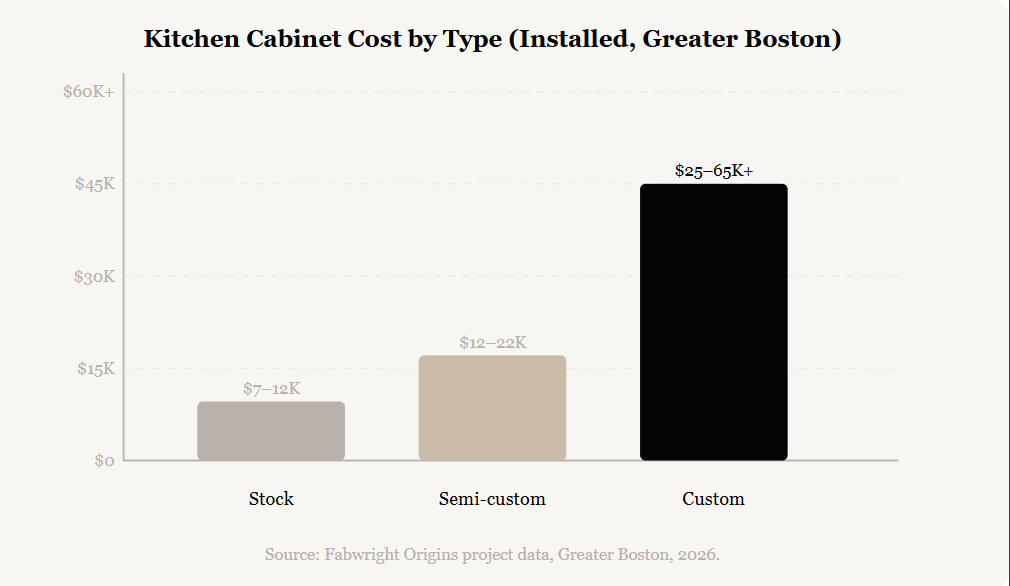
Stock cabinets are manufactured in standardized sizes and available off the shelf from big-box retailers. Installed cost runs $7,000–$12,000 for a standard kitchen. The catch: limited size increments mean filler strips, layout compromises, and wasted runs. They work fine when the kitchen is a standard rectangle with 9-foot ceilings and walls that are actually plumb.
Semi-custom cabinets are factory-made in a wider range of size increments, with more finish and door-style options. Lead time runs 6–10 weeks. Installed cost typically falls between $12,000 and $22,000. They fit better than stock, but they’re still a factory product with standard-depth boxes and minimum size constraints that matter in tight or irregular spaces.
Custom cabinets are shop-built to the exact dimensions of the specific space. Any profile, any species, any configuration. Fabrication lead runs 10–20 weeks. Installed cost: $25,000–$65,000+ depending on scope and specification.
The question isn’t which tier sounds best. It’s which tier the kitchen actually calls for. Pre-war Boston homes with non-standard ceiling heights and period profiles frequently require custom not as a luxury choice, but as an engineering necessity. A 9’4″ ceiling doesn’t work with a standard 96″ upper cabinet run. An out-of-plumb wall will never close properly against a factory-built box.
────────────────────────────────────────────────────────────────────────
How Much Does Custom Kitchen Cabinetry Cost in Greater Boston?
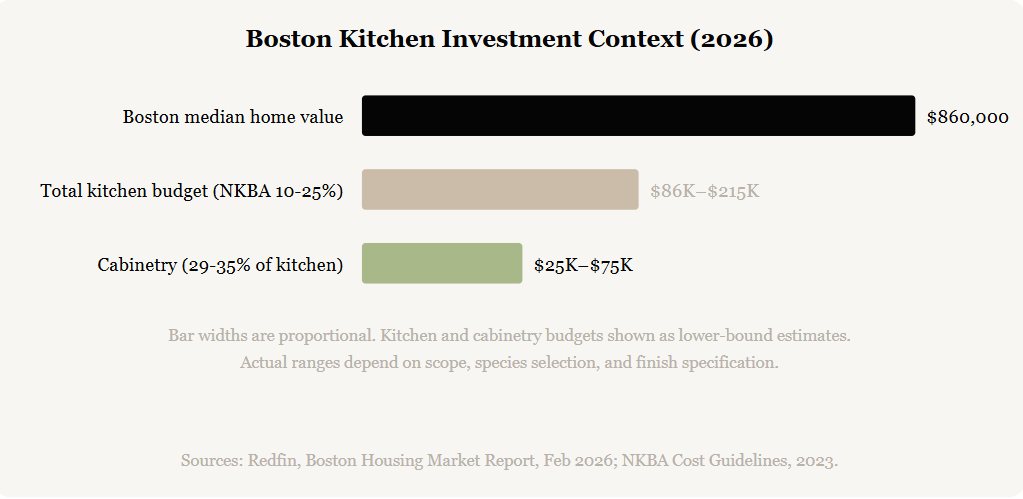
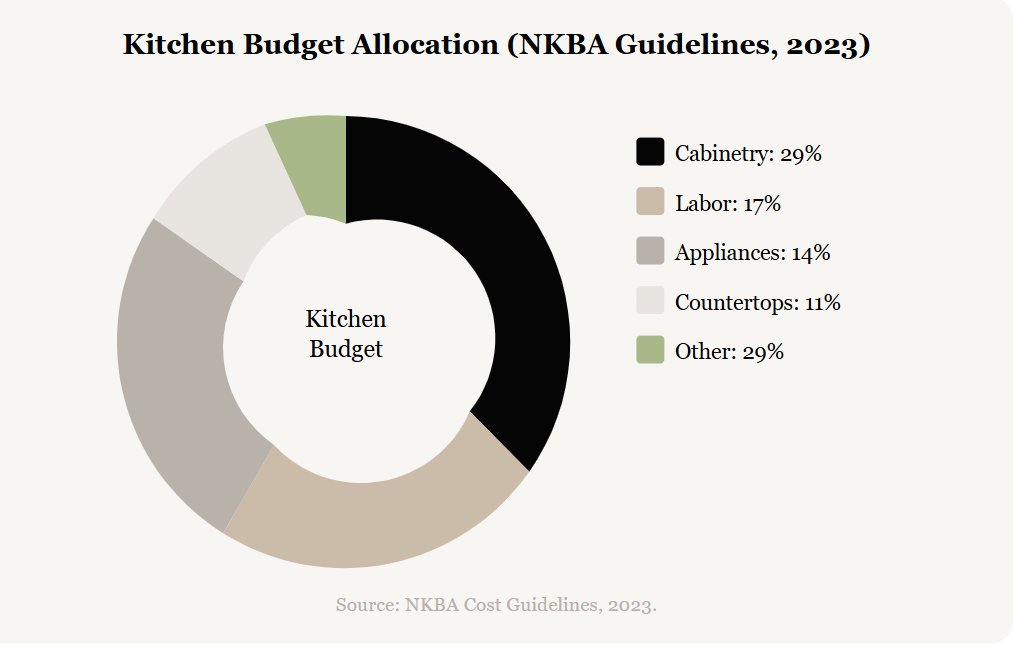
In 2025, the median major kitchen remodel in the US cost $60,000, according to the Houzz U.S. Kitchen Trends Study. In February 2026, the median home value in Boston reached $860,000, according to Redfin’s Boston Housing Market Report — and kitchen scopes here routinely run above national averages. In 2023, the NKBA Cost Guidelines established that cabinetry typically represents 29–35% of the total kitchen budget.
For the full pricing structure across all millwork scopes, see our breakdown of what custom millwork costs in Greater Boston.
Here’s how Fabwright’s custom cabinetry scopes break down for Greater Boston kitchens across Brookline, Cambridge, Newton, Wellesley, and Watertown. These figures include shop drawings, fabrication, finishing, and installation. They do not include countertops, appliances, or rough work.
- Small kitchen (under 20 linear feet): $25,000–$38,000
- Medium kitchen (20–30 linear feet with island): $38,000–$55,000
- Full kitchen with island, pantry, and integrated appliances: $55,000–$85,000+
Four factors drive price more than square footage does. Species selection is the first: poplar is the workhorse for painted cabinetry; white oak adds 15–25% for stained or natural finishes. Joinery grade comes second: dovetail or mortise-and-tenon adds 20–30% over staple and cam-lock construction, and it earns that premium in longevity. Finish type is third: spray paint on a controlled substrate is the base; hand-rubbed oil finishes add 10–20%. Hardware is fourth, and it’s a separate line item entirely — typically $2,000–$8,000 depending on pull selection and hinge specification.
What’s not in the cabinet budget: countertops, appliances, demolition, electrical, and plumbing rough-in. A $45,000 cabinetry scope can easily sit inside a $100,000+ full kitchen renovation when those other trades are priced in.
────────────────────────────────────────────────────────────────────────
What Wood Species Should You Choose for Custom Kitchen Cabinets?
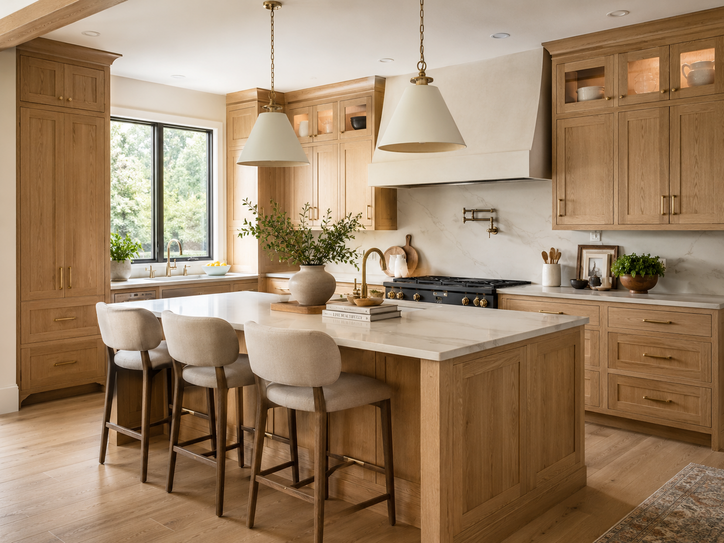
In 2025, 61% of homeowners who remodeled a kitchen chose Shaker-style cabinetry, according to the Houzz U.S. Kitchen Trends Study. Style and species are separate decisions — and confusing them is one of the most common early mistakes in a custom cabinet scope. A Shaker door can be built in poplar, white oak, walnut, or MDF. The species choice matters far more than the door profile for long-term finish performance.
For painted finishes, the right substrate is poplar or MDF-faced doors, not solid maple or oak. Poplar is stable, takes primer evenly, and moves less with seasonal humidity changes. MDF eliminates grain telegraphing entirely. The reason solid maple and oak are wrong for painted doors: open grain shows through paint, and the wood moves enough with humidity to stress finish joints over time.
For stained and natural finishes, white oak is the current preference among Boston designers — open grain, a quarter-sawn ray fleck pattern that reads beautifully at scale, and good moisture resistance. Walnut offers a deep tone and a luxury positioning that suits higher-end Newton and Wellesley projects. Hard maple is fine-grained but stains unevenly — if you choose it, that conversation needs to happen early with your fabricator.
Cherry has been a traditional Boston kitchen finish for decades. It darkens beautifully over time, but it needs a UV-stable topcoat in kitchens with significant south or west window exposure — otherwise the darkening is uneven in ways that are visible and irreversible.
We’ve finished painted kitchens in Brookline Victorians with no HVAC serving the kitchen — a real humidity-swing environment. In those conditions, MDF doors telegraph stress cracks at the joints within two to three years if the primer and sealer steps are skipped or rushed. Solid poplar doors with proper priming hold significantly better. Species and finish prep matter more in pre-war Boston kitchens than in climate-controlled new construction.
Species choice and finish type are decisions worth settling before you sit down with a fabricator — they affect species sourcing lead time and finish scheduling, not just aesthetics.
────────────────────────────────────────────────────────────────────────
AWI vs. KCMA: The Construction Standards That Actually Matter
Not all custom cabinetry is built to the same standard. The Architectural Woodwork Institute (AWI) publishes ANSI/AWI 0622.0646-2024, which defines three construction grades — Economy, Custom, and Premium — with measurable tolerances, joinery requirements, and material specifications at each level. Most production and semi-custom cabinetry falls under KCMA certification, which tests durability under lab conditions but sets no minimum for joinery method or species quality.
For a full breakdown, we’ve covered the difference between AWI and KCMA certification in depth — including the specific joinery and material requirements at each level.
Here’s what each grade actually means in practice.
AWI Economy grade is appropriate for utility spaces: laundry rooms, garage storage, and back-of-house commercial work. Staple and cam-lock construction is accepted. Lower-grade substrates are permitted.
AWI Custom grade is the residential custom standard. It requires dovetail or mortise-and-tenon joinery, void-free substrates (Baltic birch or hardwood plywood), and per-project documented finish inspection. When a fabricator says “we build custom,” this is the grade they should be able to point to. Most can’t.
AWI Premium grade tightens tolerances further and raises the finish specification. It’s appropriate for historic renovation work — where the existing millwork sets a precision benchmark the new work must match — and for commercial projects requiring tighter documentation.
KCMA certification sets performance thresholds: cycles, load, moisture resistance. That’s appropriate for rental units and spec construction, where durability under standardized lab conditions is the right benchmark. Staple and cam-lock construction is accepted. There’s no regulation of joinery method, species, or substrate quality.
So how do you ask about it? Three questions cut through the noise fast.
- “Are your cabinets built to AWI Custom or Premium grade?” — listen for whether they can define the grade without hesitation.
- “What substrate do you use for box construction, and why?” — the right answer mentions Baltic birch or void-free hardwood plywood with specific reasoning.
- “Do you provide shop drawings and a finish specification sheet?” — if the answer is no, the fabrication process isn’t documented enough to verify quality.
A fabricator who responds to the AWI question with “we build custom” without specifying a grade is not building to a standard. They’re borrowing the word.
────────────────────────────────────────────────────────────────────────
Is Custom Kitchen Cabinetry Worth the Investment for Greater Boston Homeowners?
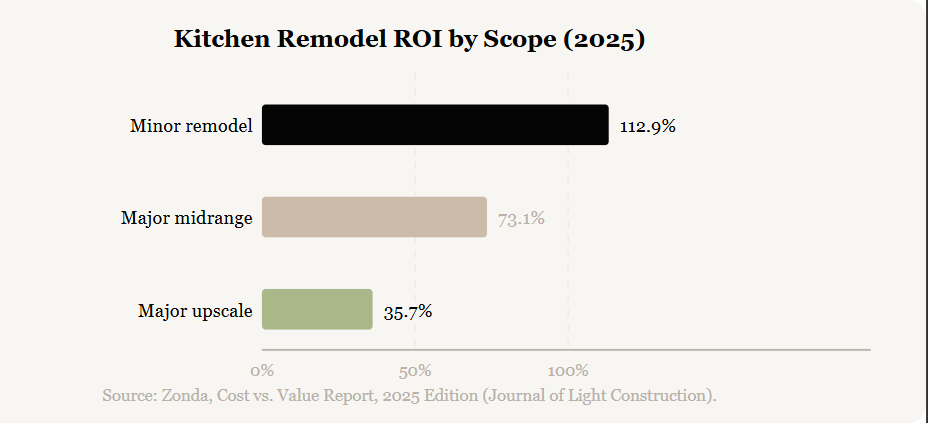
In 2025, a minor kitchen remodel returned 112.9% of its cost at resale on average, according to the Zonda Cost vs. Value Report, 2025 Edition, published by the Journal of Light Construction. A major upscale kitchen remodel returned 35.7%. The gap isn’t a statement about cabinetry quality — it’s about scope. Boston buyers value refreshed, well-finished kitchens, not just expensive ones.
We’ve broken down the full ROI breakdown for Boston homeowners in detail — including how neighborhood comps, property values, and scope size interact.
The ROI math makes more sense when you anchor it to Greater Boston home values. At the February 2026 Boston median of $860,000 (Redfin), buyers arrive with expectations calibrated to the neighborhood. A dated or builder-grade kitchen actively suppresses sale price and days-on-market. The question isn’t whether to invest — it’s whether the scope matches the home and the buyer pool.
The longevity argument is separate from the resale argument, and it’s often more compelling. AWI Custom cabinetry routinely outlasts two or three renovation cycles. KCMA production cabinets average 10–15 years before functional degradation: drawers that won’t close, doors that sag, finishes that peel at the edges. Over a 25-year horizon, custom is often less expensive per year of service.
Then there’s what we’d call the semi-custom trap. Upgrading to semi-custom in a space with a non-standard layout often produces visible filler panels, exposed unfinished sides, and run directions that don’t honor the room’s geometry. The workarounds look like exactly what they are. You’ve paid more than stock and gotten a result that still reads as a compromise.
In Greater Boston’s pre-war housing stock, custom cabinetry isn’t a style upgrade — it’s an engineering necessity. A 9’4″ ceiling in a 1920s Newton colonial doesn’t work with 96″-tall stock upper boxes. A corner cabinet in a kitchen with a wall that’s 2″ out of plumb will never close properly with factory-built boxes. The custom premium buys fit as much as it buys finish.
────────────────────────────────────────────────────────────────────────
Start a conversation with Fabwright →
────────────────────────────────────────────────────────────────────────
What Makes Greater Boston Kitchens Different — and Why It Affects Your Millwork?
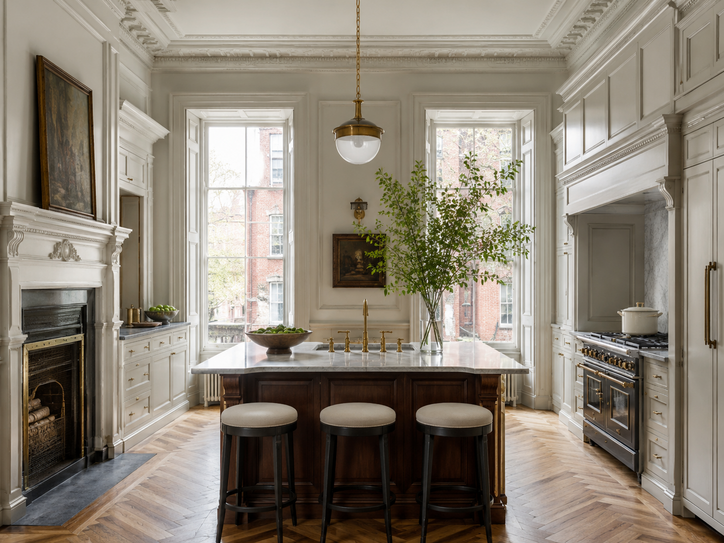
Greater Boston’s residential housing stock is among the oldest in the country. In neighborhoods like Brookline, Cambridge, Newton, and Watertown, pre-war construction from 1900 to 1940 dominates. That means out-of-plumb walls, non-standard ceiling heights, and period millwork profiles that no factory catalogue has ever been asked to match. These aren’t cosmetic challenges — they’re structural conditions that determine which kind of cabinetry will actually fit.
Why does this matter so much more here than in other markets? Because the gap between a well-fitting kitchen and a compromised one shows. Period architecture has a logic — proportions, profiles, sight lines — and cabinetry that ignores that logic reads as an intrusion rather than a renovation.
Ceiling heights are the most common source of compromise. Pre-war Boston kitchens frequently run 8’2″ or 9’6″ rather than the 9′ flat that stock upper cabinet runs assume. The only real solutions are stack-on crown molding, custom-height boxes, or a furred-down soffit that announces itself as a workaround. Custom fabrication solves this at the shop drawing stage — not on installation day.
Wall conditions in lathe-and-plaster construction are rarely plumb or flat over a full cabinet run. Scribing a cabinet to a wavy wall requires measuring the deviation at multiple points, cutting a profile into the stile that follows that deviation exactly, and fitting to within a fraction of an inch. That’s a skilled trade. Factory-fit boxes get shimmed and caulked, and it shows.
Period profiles are another factor that stock yards don’t address. Colonial casing, Arts and Crafts face frames, and Victorian raised-panel details each have proportional logic. A Shaker door in a 1920s colonial isn’t wrong because it’s modern — it’s wrong because the proportions are off. Custom milling lets you match the scale and language of what’s already there.
In a Watertown colonial we worked on, the ceiling height varied by 1¾” from one end of the kitchen to the other across a 22-foot run. A factory upper cabinet run would have required visible fillers at both ends and a scribed crown that didn’t match the existing cornice profile. Custom fabrication let us scribe the boxes to the ceiling plane and run a continuous period-appropriate profile from wall to wall. The result reads as if the cabinets had always been there — which is the goal.
────────────────────────────────────────────────────────────────────────
The Fabwright Kitchen Process: From Shop Drawings to Installation
A custom kitchen cabinetry scope with Fabwright begins 10–20 weeks before installation day — not because fabrication is slow, but because precision work requires time at every stage. In our experience across Greater Boston kitchen projects — from Brookline Victorians to new Cambridge builds — a full kitchen renovation, from design kick-off through punch list, typically takes 3–6 months. It’s worth understanding what happens inside that timeline.
For a closer look at the software layer, we’ve written about how we use Microvellum and Cabinet Vision to deliver precision cabinetry — including how CNC nesting translates a shop drawing into a cut list without dimensional drift.
Here are the six stages and what each one involves.
Stage 1: Design consultation and site measurement. This isn’t a quote form. We’re measuring ceiling height variance at multiple points, wall plumb across the full run, existing trim profiles and their dimensions, and door swing clearances. We’re also having a design conversation: run direction, hardware preferences, finish goals, how the kitchen connects to adjacent spaces.
Stage 2: Shop drawings. Every joint, every dimension, every elevation — drawn, reviewed, and client-approved before a single piece of material is cut. This is where most of the real design work happens, and where most problems get solved in two dimensions rather than in wood.
Stage 3: CNC fabrication. Parts are cut to tolerance on our ShopSabre router, with Microvellum and Cabinet Vision software handling precision nesting and part optimization. CNC fabrication gives us the repeatability and tolerance control that hand-cutting alone can’t match at this scale.
Stage 4: Hand assembly. Joinery fitted, boxes glued and clamped, face frames applied. Dovetails cut, fitted, and checked. This is where the CNC-cut parts become furniture.
Stage 5: Finishing. Spray-applied in a controlled environment, with sanding between coats and a color-matched sample reviewed and approved before full application begins. Finishing in a controlled environment — not on-site — is what separates a consistent result from a patchy one.
Stage 6: Delivery and site installation. Scribing to ceiling and wall planes, shimming for level and plumb, hardware mounting and adjustment, final punch list walk-through.
The shop drawing approval step is where most custom projects either succeed or stall. Clients who engage seriously with the drawings — who ask about run direction, door swing clearances, and drawer stack heights — catch 90% of the problems before they’re built in wood. Clients who sign drawings without reading them discover those problems on installation day, when fixing them costs ten times as much. Reviewing shop drawings isn’t paperwork. It’s the most important hour you’ll spend on the project.
────────────────────────────────────────────────────────────────────────
What Should You Ask Before Hiring a Custom Cabinet Maker in Greater Boston?
Hiring a custom fabricator is different from hiring a general contractor. You’re choosing a long-term craft partner who will build permanent work into your home. The right questions reveal more than any quote sheet — and the wrong fabricator chosen for the right price will cost you far more than the savings.
If you’d like more context before that first conversation, our guide explains what architectural millwork means for kitchen projects and how the vocabulary of the trade maps to actual decisions.
Here are eight questions that separate capable fabricators from commodity operations.
1. Are your cabinets built to AWI Custom or Premium grade? A capable fabricator answers this without hesitation. They can tell you what the grade requires and why they build to it. If the response is “we build custom” without referencing the AWI standard, keep asking. The grade has a precise definition. Vague answers mean vague standards.
2. Do you produce shop drawings, and do clients approve them before fabrication begins? Shop drawings are where the real design work happens. A “yes” here is non-negotiable. Ask to see an example.
3. What substrate do you use for cabinet boxes — and why? The right answer mentions Baltic birch, void-free hardwood plywood, or solid wood with specific reasoning for the choice. “Whatever works” isn’t a specification.
4. How do you handle out-of-plumb walls and non-standard ceiling heights? Listen for scribing, shimming, and field measurement. Fabricators who work from standard dimensions only will fudge the fit. In pre-war Boston kitchens, that fudge is visible.
5. Can I visit your shop or see a project in progress? Any fabricator building work they’re proud of will say yes. Hesitation or deflection here is its own answer.
6. What’s your current lead time for a kitchen of this scope? Ten to twenty weeks for custom fabrication is normal. Less than eight weeks should prompt questions about what’s actually being built — and whether it’s actually custom.
7. Do you handle installation, or do you subcontract it? Either answer is acceptable. But if installation is subcontracted, you need to know who’s doing the fitting work and what their experience level is with pre-war Boston conditions.
8. What does your finish process look like? Listen for: controlled environment, number of coats, sanding between coats, approved sample before full application. “We spray it in the shop” is incomplete. “We spray it in the shop, sand between coats, run a color-matched sample for approval, and apply three finish coats in a temperature-controlled environment” is a process.
────────────────────────────────────────────────────────────────────────
Frequently Asked Questions
How much does custom kitchen cabinetry cost in Greater Boston?
Custom kitchen cabinetry in Greater Boston typically runs $25,000–$38,000 for a small kitchen (under 20 linear feet), $38,000–$55,000 for a medium kitchen with an island, and $55,000–$85,000+ for a full scope with integrated appliances and pantry. These figures include shop drawings, fabrication, finishing, and installation (Fabwright Origins project data, 2026).
How long does a custom kitchen cabinet project take from design to installation?
A full custom kitchen — from initial design consultation to installation punch list — typically takes 3–6 months in Greater Boston, based on Fabwright’s project experience across Brookline, Cambridge, Newton, and Wellesley. Fabrication alone runs 10–20 weeks from shop drawing approval. Design, site prep, and rough work add time on either end.
What’s the difference between custom and semi-custom kitchen cabinets?
Custom cabinets are shop-built to the exact dimensions of your specific kitchen — any size, any species, any profile. Semi-custom cabinets are factory-made in a wider range of size increments than stock, with more finish options, but remain factory products with minimum size constraints and standard-depth boxes.
Is it worth paying for AWI Custom grade over standard production cabinetry?
For Greater Boston homeowners with pre-war homes, non-standard ceiling heights, or a kitchen they plan to keep for 20+ years, AWI Custom grade — with its joinery and material standards — pays back in longevity. In 2025, minor kitchen remodels returned 112.9% at resale on average (Zonda Cost vs. Value Report, 2025 Edition).
What wood species do Boston custom cabinet makers recommend for painted kitchens?
For painted kitchen cabinets in Greater Boston, Fabwright typically specifies poplar or MDF-face doors on solid-wood frames. Poplar is stable, takes primer and paint evenly, and moves less than maple or oak with seasonal humidity swings — a real consideration in pre-war Boston homes with plaster walls and variable insulation.
────────────────────────────────────────────────────────────────────────
The Bottom Line
Custom kitchen cabinetry in Greater Boston isn’t a luxury category. In pre-war homes with non-standard geometry, it’s the only specification that actually fits the architecture. Stock and semi-custom boxes are the right choice for standard rectangular kitchens with flat ceilings and plumb walls — but that describes a fraction of Greater Boston’s housing stock.
AWI Custom grade is the construction benchmark that separates craft work from commodity production. It has a definition, measurable standards, and joinery requirements that can be verified. The right fabricator can explain it without prompting.
The ROI data is clear: a 2025 minor kitchen remodel returned 112.9% on average, according to the Zonda Cost vs. Value Report. The investment pays back when scope and specification are matched to the home — not when they’re matched to a showroom display.
The eight questions in this guide are the fastest way to tell whether a fabricator is actually building to a standard. Ask them before you sign anything.
Start a conversation with Fabwright →
If you’re still weighing options, our full breakdown of what custom millwork costs in Greater Boston covers pricing structure across all millwork scopes.
────────────────────────────────────────────────────────────────────────
Sources
1. Houzz, U.S. Kitchen Trends Study, retrieved 2026-05-27, https://www.houzz.com/magazine/2025-u-s-houzz-kitchen-trends-study-stsetivw-vs~175635143
2. Zonda, Cost vs. Value Report, 2025 Edition (Journal of Light Construction), retrieved 2026-05-27, https://www.jlconline.com/cost-vs-value/2025/
3. Redfin, Boston Housing Market Report, February 2026, retrieved 2026-05-27, https://www.redfin.com/city/1826/MA/Boston/housing-market
4. NKBA, 2024 Market Outlook Report, retrieved 2026-05-27, https://nkba.org/research/
5. NKBA, Cost Guidelines for Kitchen Remodeling, 2023, retrieved 2026-05-27, https://nkba.org/research/
6. Principia, US Cabinet Market Report, 2022, retrieved 2026-05-27, https://www.principiaconsulting.com/
7. Harvard JCHS, Improving America’s Housing 2025, retrieved 2026-05-27, https://www.jchs.harvard.edu/sites/default/files/reports/files/Harvard_JCHS_Improving_Americas_Housing_2025.pdf
8. AWI, ANSI/AWI 0622.0646-2024 Architectural Woodwork Standards, retrieved 2026-05-27, https://www.awinet.org/
────────────────────────────────────────────────────────────────────────