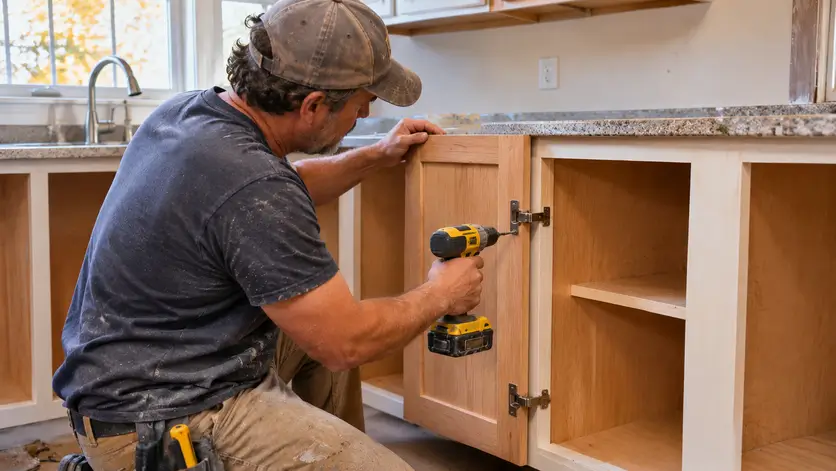
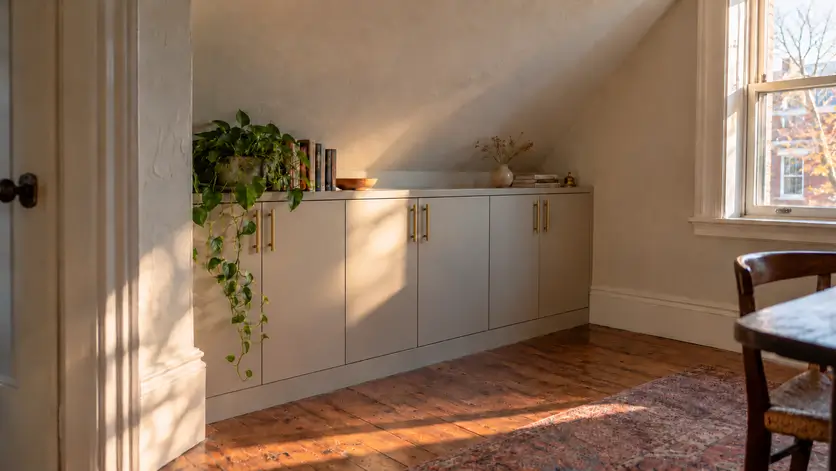
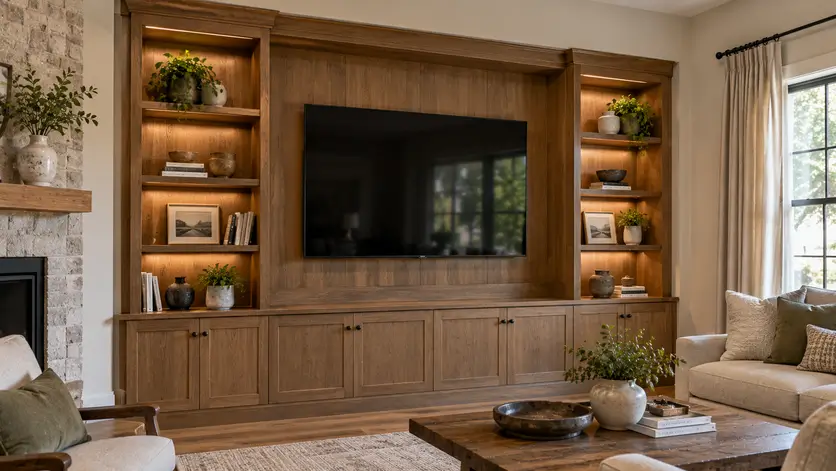
Custom built-ins can add value to a Boston-area home, turning bare walls and awkward corners into storage and woodwork that read as part of the house. For homeowners from Cambridge to Quincy, this guide covers planning pieces that keep their worth, when they help or hurt a sale, which ones buyers favor, why older homes suit them, and what stays when you sell.
Key Takeaways
- Plan for the room you will leave behind, not the things you own now, so the woodwork still looks like it belongs.
- Add a built-in to fix a real shortcoming in the house; skip it if it shrinks a room below what daily use requires.
- Favor storage any household would use over a piece shaped around your own hobby, which the next owner may not share.
How should you plan built-ins so they hold their value?
Planning custom built-ins that hold their value starts with the room, not with what you own today. Line each piece up with something fixed, such as a window casing or the existing trim profile, so it reads as original work instead of an add-on.
Keep the interior flexible. Adjustable shelves and openings sized for everyday use suit whoever lives there next; a cabinet cut to fit one particular television serves only you.
Then ask what the cabinet boxes are made of. Composite wood panels fall under the EPA’s formaldehyde emission standards for composite wood products, set by a final rule published on December 12, 2016, and updated by a final rule in October 2026 that further aligns the federal rule with California’s. Ask your maker which panel stock goes into the boxes and whether it meets that federal standard. Those panels stay in the house for as long as the built-ins do.
When built-ins add value to a house, and when they don’t
Built-ins add value when they solve a problem the house has, such as a hallway with no closet or an alcove that loose furniture cannot use, and when the work is good enough to read as part of the architecture. They work against you when they eat into floor area a room needs to function. Poor construction also counts against them: shelves that sag, doors that stop closing true. Before committing, weigh what the room gives up, including the freedom to rearrange it later.
Which built-ins do home buyers appreciate most?
The built-ins a buyer has least reason to question do a job every household has: a mudroom bench, a pantry wall, shelving beside a fireplace. Pieces built around one owner’s hobby ask the next owner to share it. Finish counts too, since paint-grade or stain-grade cabinetry changes how a piece reads.
| Built-in | What any household gets | What narrows its appeal |
|---|---|---|
| Mudroom bench and lockers | Coat and boot storage at the entry | Cubbies sized for one family’s gear |
| Pantry cabinetry | Food and dish storage by the kitchen | Shelves so deep that items get lost |
| Shelving beside a fireplace | Display space framing the focal point | A finish at odds with the trim |
| Window seat with drawers | Seating and storage in an alcove | Fabrics picked for one taste |
Why do built-ins suit older homes and small rooms?
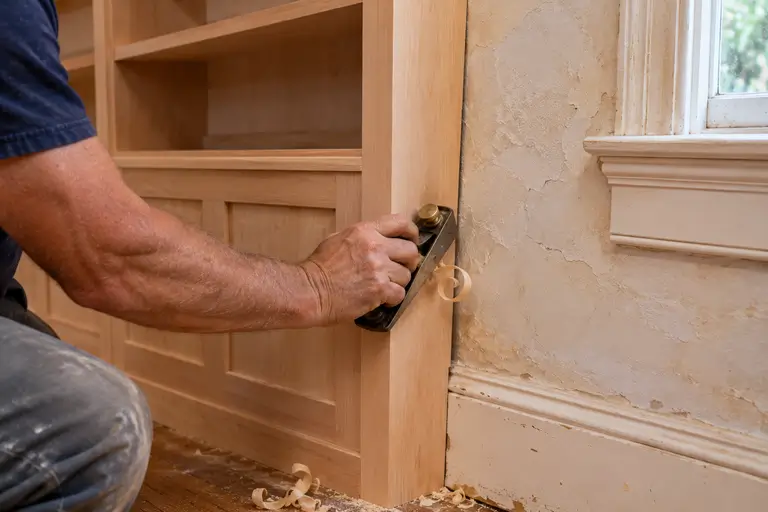
Built-ins suit older homes because they are built for the room as it stands, crooked walls included. They suit small rooms because they reach space a freestanding piece cannot use. A plaster wall that bows or a floor that slopes leaves gaps behind a store-bought bookcase. A built-in is scribed, which means its edges are cut to follow the wall’s real line, so it sits tight without shims showing.
If your house in Cambridge, Newton or Roslindale is an older one, the trim matters as much as the fit, and our work on millwork for historic and brownstone homes shows how new pieces are matched to original detail. Weighing the spend is its own question, taken up in our guide to whether custom cabinets are worth it. The cost of custom millwork rises with the scribing and fitting an out-of-square room demands.
Built-ins or freestanding furniture: which stays with the house when you sell?
A built-in stays with the house. It is fastened to the walls and floor, so it is sold along with the rooms it was made for. A freestanding bookcase or dresser leaves on the moving truck, and whatever it is worth goes with you.
Being fixed to the wall also changes the safety picture. ASTM International’s F2057 standard sets tip-over resistance requirements for freestanding clothing storage units such as dressers, a risk that built-in, wall-anchored storage avoids.
Because the cabinet boxes stay behind, the next owner lives with what they are made of. Birch plywood is our preferred material for most cabinetry because of its quality and longevity, and we generally use solid hardwoods for trim.
If you are timing built-ins ahead of a sale, our projects take approximately 6 to 8 weeks from consultation to installation, depending on the size and complexity of the job. To talk through a room in your home, get in touch with Fabwright Origins or call us at 617-506-9293.
Sources
- Formaldehyde Emission Standards for Composite Wood Products | US EPA, U.S. Environmental Protection Agency (EPA), retrieved 2026-11-15.
- F2057 Standard Safety Specification for Clothing Storage Units, ASTM International, retrieved 2026-11-15.