CNC fabrication means making parts with a machine that follows a digital program rather than a hand-guided tool. CNC stands for computer numerical control. In millwork, an approved drawing becomes a cut file, and a router shapes plywood, MDF or hardwood into cabinet boxes, panels and trim that match the design, whether the job calls for one piece or a full floor of matching units.
Key Takeaways
- CNC fabrication means a computer-guided machine cuts and shapes material by following a checked digital design file.
- Precision is set in shop drawings and cut files; skilled people still design, check, assemble and finish.
- CNC cost depends on material, unique parts, design time and finish more than on machine time.
What does CNC fabrication mean, and how does it differ from custom fabrication?
CNC fabrication means a machine moves its cutter along coordinates written in a program, so every cut comes from the file, not a tape measure. The federal Manufacturing.gov page on computer numerical control describes CNC as machine tools run by programmed instructions instead of manual control, the same principle a millwork router works on.
CNC fabrication vs. custom fabrication
Custom fabrication describes what gets made: a piece built for one space. The U.S. Census Bureau’s NAICS entry for custom architectural woodwork and millwork manufacturing defines that industry by custom-designed interiors and fixtures, not by the tools used, so a shop in it may cut by CNC, by hand, or both.
Most custom millwork is both: designed for your room and cut by CNC.
What Is CNC Fabrication?
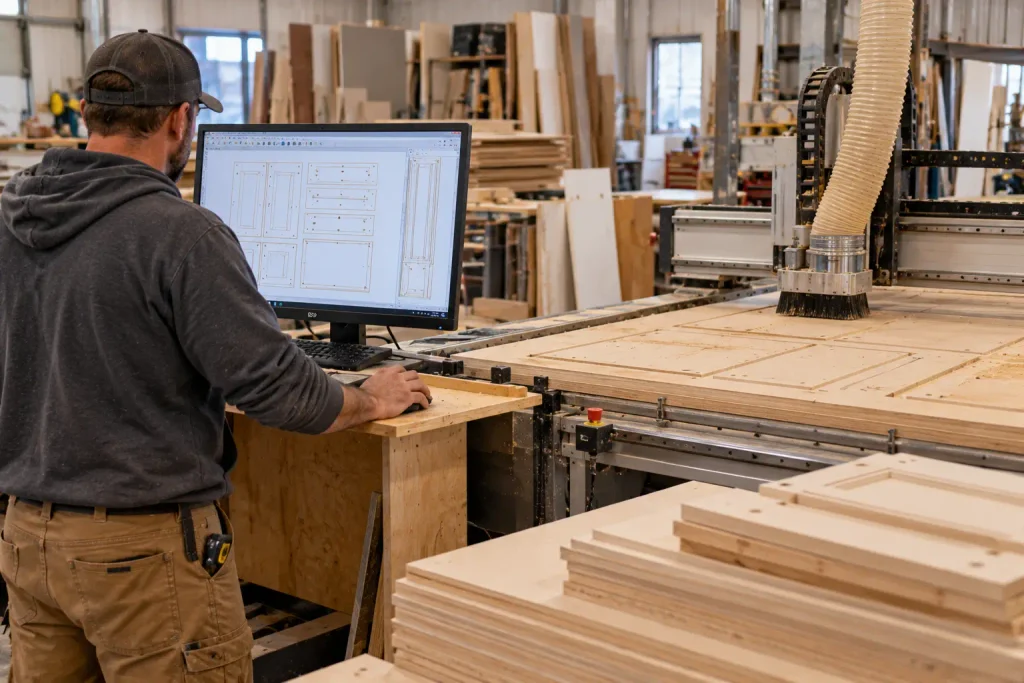
On a millwork shop floor, the machine is usually a CNC router. A full sheet of plywood or MDF lies on a flat table, and a spinning cutter on a moving gantry travels side to side, front to back and up and down along toolpaths written by software.
The router makes no decisions. It reproduces the file exactly, errors included, which is why the checking happens before cutting.
What does CNC mean in construction?
On a job site, CNC refers to parts made off site by programmed machines and delivered ready to install: cabinet boxes, wall panels, stair parts, reception desk components. Less gets cut and fitted in the room, and more arrives matched to the drawings.
Does CNC fabrication involve machine maintenance?
Yes. A dull cutter, a worn spoilboard or a gantry out of calibration shows up as fuzzy edges or parts that are slightly off, so accuracy depends on keeping the machine tuned as much as on the file.
How does CNC fabrication work in millwork construction, from drawing to finished part?
A CNC project moves from approved drawings to a cut file, then to the machine, then to assembly and finish. Precision is set before any cutting, because the router reproduces whatever the checked file says. CNC fabrication supports millwork construction in five steps:
- Shop drawings. Dimensions, reveals, hardware and site measurements are drawn and approved.
- Cut file. In our shop, Microvellum and Cabinet Vision turn the cabinet model into a parts list, edgebanding callouts and machining data from a single source. This walk-through of Microvellum and Cabinet Vision for precision cabinetry shows that stage.
- Nesting. Parts are arranged on each sheet to limit waste.
- Cutting. Our ShopSabre router cuts, drills and grooves each part, including shelf-pin holes and dados, in the same pass. See how a ShopSabre CNC router affects fabrication precision.
- Assembly and finish. Edgebanding, assembly and finishing remain skilled hand work.
The handoff I watch most closely is between steps one and two. A change agreed on site has to make it into the model, or the router will faithfully cut the old dimension.
How does CNC fabrication compare with traditional woodworking?
CNC wins on repeatability and complex geometry. Traditional woodworking wins on one-off adjustment and hand detail. The BLS Occupational Outlook Handbook for woodworkers notes that woodworkers increasingly set up and run computer-controlled machinery, the same shift in skill the table below shows, and good millwork uses both kinds of work.
| Factor | CNC fabrication | Traditional woodworking |
|---|---|---|
| Consistency across pieces | Each part matches the file | Depends on the maker’s technique |
| Curves and patterns | Cut directly from the file | Slow, template-driven work |
| Changes mid-project | Edit the file and recut | Adjust by hand at the bench |
| Where skill goes | Drawing, programming, checking, finishing | Measuring, cutting, fitting |
| Best fit | Repeated units, panels, casework | Unique details, carving, restoration |
CNC does not remove craft. It moves skilled labor toward planning and finishing.
Why is CNC fabrication critical for commercial millwork?
Commercial millwork repeats the same elements across many rooms and must meet lighting, power and building systems at exact points. CNC keeps every unit matched to the approved file, so pieces fit with fewer field adjustments and trades stay on schedule.
Production from approved files also keeps finished work true to the commercial designs the architect drew, which puts CNC at the center of quality control on offices, retail and hospitality interiors.
Where does CNC fabrication show up in construction: cabinets, built-ins and architectural millwork?
CNC shows up wherever millwork is cut from sheet goods or must repeat exactly. That covers a kitchen in Newton as readily as an office fit-out in Cambridge:
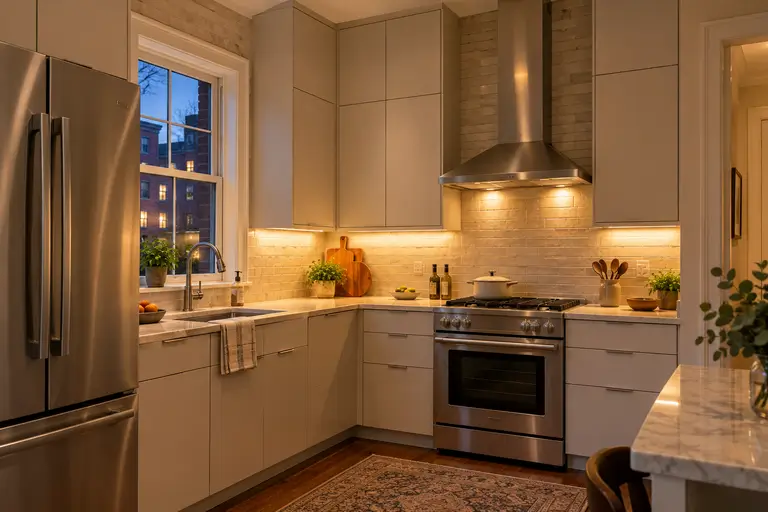
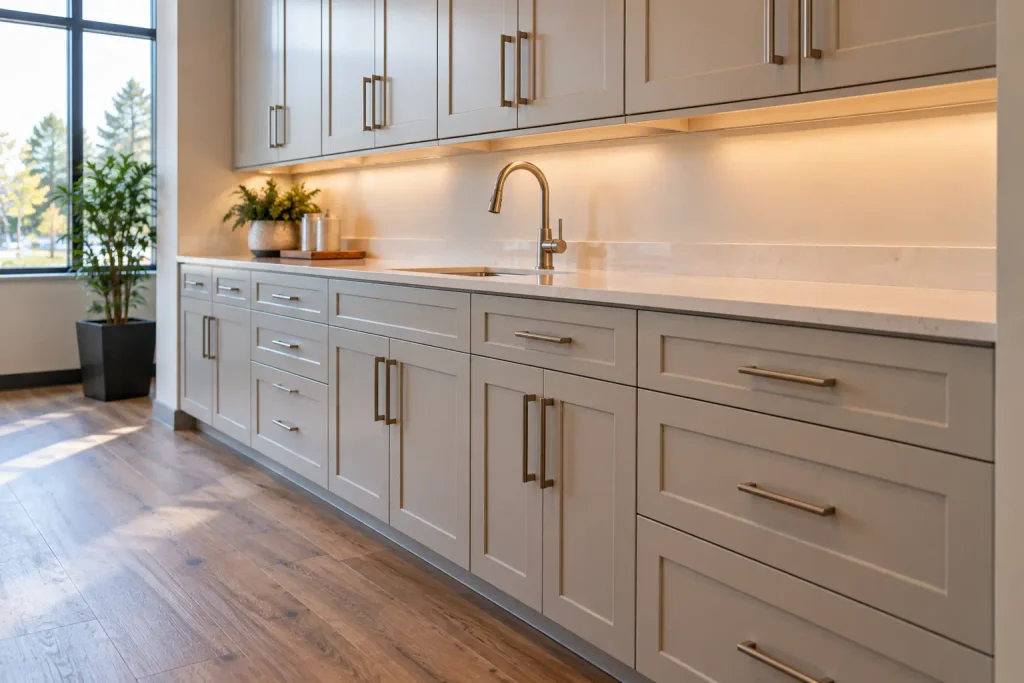
- Kitchen cabinetry and luxury cabinetry, where boxes, doors and drawer fronts must align
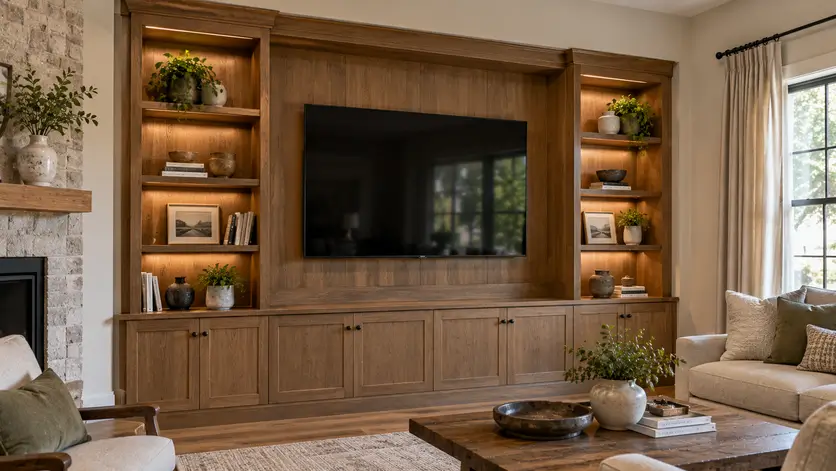
- Built-in cabinetry, custom wall units and media centers
- Custom paneling, feature walls and mixed media wall treatments
- Reception desks and decorative architectural elements with curves or patterns
For trim, paneling or feature walls, see our architectural millwork services. This guide to CNC fabrication for custom furniture goes further.
What does CNC change about cost, lead time and consistency?
CNC improves consistency most, shortens cutting time, and shifts cost toward design and engineering.
What drives the cost of CNC millwork?
- Material. Paint-grade MDF sits at the lower end, veneered plywood in the middle, and solid hardwoods such as white oak or walnut at the top, since they add milling time and waste.
- Unique versus repeated parts. A run of matching condo kitchens spreads programming across every unit; a single curved reception desk carries all of its drawing time alone.
- Design and shop-drawing time. Curves, integrated lighting and coordination with electricians or other trades add hours before any cutting.
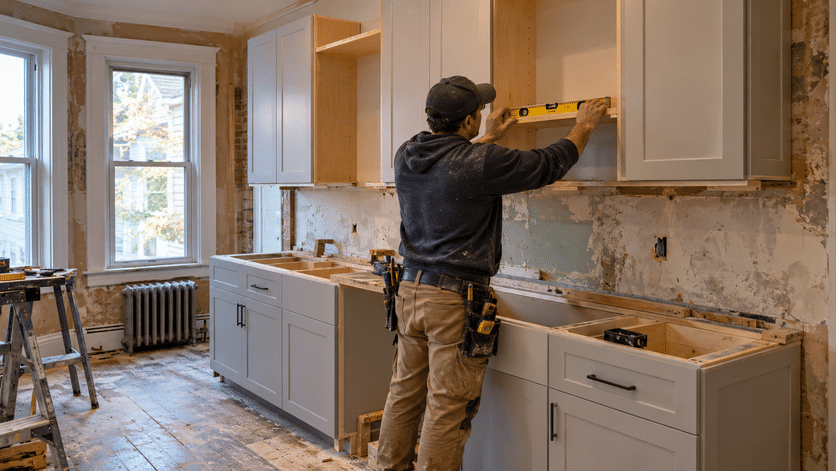
- Finish, hardware and site conditions. Older Boston-area houses, from Somerville triple-deckers to Brookline brownstones, rarely have plumb walls, so installs need scribes and fillers. Downtown condo buildings often require elevator reservations and set delivery windows.
USDA Forest Service research on the conversion economics of CNC manufacturing analyzes the financial risk a wood shop accepts when it invests in CNC equipment, a cost recovered across many jobs rather than on any one piece. For more on pricing, read our custom millwork cost guide.
How long does CNC millwork take?
Lead time depends more on drawings, approvals and finishing than on the router; cutting is usually the shortest step on the schedule. The calendar goes to site measurement, rounds of shop-drawing review, ordering specialty veneers or hardware, and finishing and curing time. In older homes around Boston, final measurements often wait until walls are open or replastered, because out-of-square conditions only show up then, and dry winter heat makes acclimating solid wood worth the wait.
Where does the consistency come from?
From the file. Once a drawing is approved, the last unit off the router matches the first.
Who uses CNC fabrication?
Architects, designers, developers, builders, commercial property owners and residential homeowners all use CNC fabrication when design intent and fabrication accuracy must line up.
Each group wants something slightly different. Architects need built work to match drawings, developers need predictable timelines, owners need durable millwork, and homeowners want consistent reveals in custom cabinetry.
What is design-assist?
Design-assist means the fabricator reviews drawings early, so the team can refine a design with fabrication in mind before details are locked.
How do you choose a shop or CNC fabrication partner like Fabwright Origins?
Choose a shop that shows you shop drawings before cutting, explains how a design file becomes a machined part, and holds a valid license. Ask:
- Will I approve shop drawings before material is cut?
- Does the shop guard its machines to federal rules? OSHA’s interpretation on guarding abrasive wheels on CNC contouring machines shows that federal machine-guarding requirements apply to computer-controlled equipment, not only hand-fed tools, so ask how the router is guarded.
- Is the contractor licensed in Massachusetts?
Our guide to choosing a cabinet maker in Boston adds more questions. Fabwright Origins holds Massachusetts trade license #206685 and serves Boston, Cambridge, Newton, Wellesley, Quincy and nearby towns.
I came to millwork from engineering at MIT, and that training shapes how I run a job. I read a shop drawing the way an engineer reads a specification, and I would rather settle a reveal or a scribe on screen with a client than discover it on the wall. Whether I am working with homeowners or design professionals, clients stay involved from first drawing to finished piece. Explore our contract CNC fabrication services, or contact Fabwright Origins to talk through your project.
Frequently Asked Questions
What does CNC fabrication mean in simple terms?
CNC fabrication means a computer-controlled machine cuts and shapes material by following a digital design file. In millwork, that turns approved drawings into cabinet parts, panels and trim that match the design, without relying only on hand measurement.
Why is CNC fabrication commonly used in commercial millwork?
Commercial millwork repeats elements across many rooms and must fit around building systems. CNC keeps every piece matched to the approved file, which reduces field adjustments and keeps the finished space true to the design.
How does CNC fabrication support millwork construction projects?
It links design and production directly. Working from checked digital files reduces variation between components, so cabinets, panels and built-ins go together cleanly on site. Skilled people still handle drawings, assembly and finishing.
Is CNC fabrication only for large commercial projects?
No. CNC fabrication serves residential homeowners as well as commercial clients. A single kitchen or built-in wall gains the same consistent reveals, clean joinery and accurate fit that a multi-unit project needs.
What should clients look for in a CNC fabrication partner?
Look for millwork experience, a shop-drawing approval step before cutting, clear communication and a valid state license. Ask how design files become machined parts. Planning and collaboration matter as much as the equipment.
Sources
- Computer Numerical Control – Manufacturing.gov, retrieved 2026-09-25
- North American Industry Classification System (NAICS) – U.S. Census Bureau, retrieved 2026-09-25
- Woodworkers: Occupational Outlook Handbook – U.S. Bureau of Labor Statistics, retrieved 2026-09-25
- Conversion economics of forest biomaterials: risk and financial analysis of CNC manufacturing – US Forest Service Research and Development, retrieved 2026-09-25
- Guarding and the use of abrasive wheels in CNC contouring machines – Occupational Safety and Health Administration, retrieved 2026-09-25