Almost every homeowner we speak with uses the words “millwork” and “cabinetry” interchangeably. Most of the time, it doesn’t matter. You know what you want — a built-in, a kitchen, a pantry wall — and the terminology is secondary to getting the scope right.
But sometimes the distinction does matter. It changes who you hire, which fabrication standards apply, how long the project takes, and what you’re actually getting for your money. Knowing what architectural millwork is and how it’s built is one thing — knowing where cabinetry sits within that definition is where most renovation conversations go sideways.
This is the explanation we give our own clients at Fabwright when the terms come up.
Key Takeaways
- Cabinetry is a subset of millwork — all custom cabinetry is millwork, but not all millwork is cabinetry. The distinction determines fabrication standards, lead times, and who you should hire.
- In 2025, semi-custom cabinets hold 46.39% of the global cabinet market (Mordor Intelligence, 2025) — but custom millwork-grade cabinetry is the premium end of that spectrum.
- From design approval to installation: stock cabinets ship in 1–4 weeks. Custom architectural millwork runs 10–20 weeks. The difference in time reflects the difference in what you’re getting.
──────────────────────────────────────────────────────────────────────
Is Cabinetry the Same Thing as Millwork?
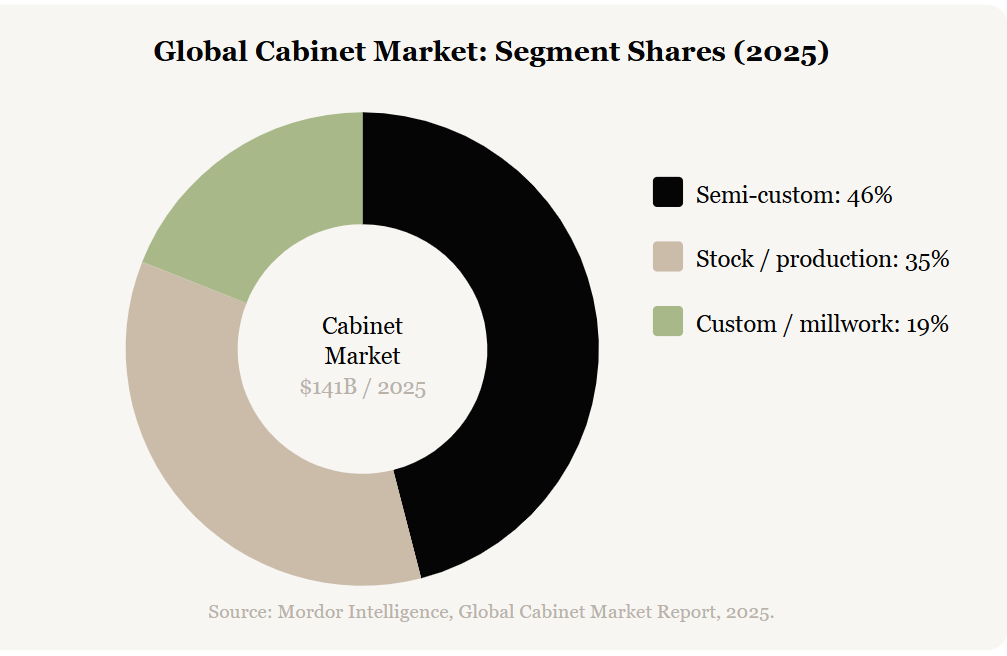
Yes — and no. In 2025, the global cabinet market reached $141 billion, with semi-custom products holding the largest share at 46.39% (Mordor Intelligence, Global Cabinet Market Report, 2025). That dominant mid-range segment is where production cabinetry — factory-made boxes in standard dimensions — lives. Custom cabinetry, built to specification for a specific space, sits at the upper end of that same market. And custom cabinetry, by definition, is millwork.
The word “millwork” has an old etymology: anything fabricated in a mill. Historically that included flooring, doors, windows, trim, and cabinetry — anything processed from raw lumber into a finished wood product. Over time, the production side of the cabinet industry moved to factories and standardized sizes, and the term “cabinetry” started to carry that factory-made association. “Millwork” came to mean the custom-fabricated end of the spectrum.
The practical distinction today comes down to a three-part spectrum:
- Stock cabinetry is factory-made in standard dimensions — typically in 3-inch increments — and sold off the shelf at big-box stores and cabinet dealers. Filler strips bridge the gaps where standard sizes don’t fit. What you see in the showroom is what ships to the site.
- Semi-custom cabinetry offers more size and finish options than stock, but is still produced in a factory to a limited range of specifications. Lead times are longer than stock, and the result is more tailored — but the boxes are still made in a production environment to KCMA standards, not to your exact measurements.
- Custom millwork cabinetry is built to your exact dimensions, your profile choices, your materials, and your finish. Every component is fabricated for your specific project. This is the architectural millwork end of the spectrum — and it’s governed by different standards entirely.
Custom cabinetry and millwork aren’t different categories — they’re the same category at different points on the production spectrum. In 2025, the global cabinet market hit $141B with semi-custom products capturing 46.39% of share (Mordor Intelligence, 2025). Custom millwork-grade cabinetry represents the precision-fabricated, made-to-specification premium end — governed by AWI quality grades, not KCMA factory standards.
──────────────────────────────────────────────────────────────────────
How Fabrication Standards Differ: AWI vs. KCMA
The clearest way to understand the millwork/cabinetry distinction is through the two bodies that govern them. As of November 15, 2024, the Architectural Woodwork Institute published the new ANSI/AWI 0622.0646–2024 standard — superseding the prior edition from 2014 — which governs the fabrication of custom millwork, trim, and shop-fabricated assemblies. KCMA (Kitchen Cabinet Manufacturers Association) governs production cabinetry through its ANSI/KCMA certification program. These two bodies describe two different industries.
AWI quality grades define three tiers of architectural woodwork:
- Economy grade meets the minimum fabrication standard for functional performance. Material defects are accepted within defined limits. Joinery is functional but not necessarily refined.
- Custom grade is the specification most high-end residential and commercial projects require. Joinery standards are tighter, material selection excludes visible defects, and finish quality is held to a documented standard. This is what Fabwright builds to.
- Premium grade sets the highest AWI standard — close-tolerance joinery, matched grain across panels, premium material selection, and finish inspection at every stage. Used for museum-quality installations, flagship commercial work, and the most demanding residential commissions.
KCMA certification guarantees that a production cabinet meets specific structural and finish performance tests — resistance to heat, moisture, and impact. It doesn’t address design customization or grain-matching. It confirms that a factory-made product meets a durability threshold. That’s a meaningful guarantee for semi-custom kitchen cabinetry. It’s a different kind of guarantee than AWI Custom grade.
The AWI vs. KCMA question is the single best contractor vetting question most homeowners never ask.
Most homeowners have never heard of AWI or KCMA — and most contractors won’t bring it up. But asking “Do you build to AWI Custom grade or KCMA?” is the single most revealing quality-assurance question you can ask before signing a contract. A fabricator who builds to AWI Custom grade will know immediately what you’re asking. One who doesn’t will either look it up or give you a vague answer. Both tell you something important.
As of November 2024, the ANSI/AWI 0622.0646–2024 standard governs fabrication of custom millwork and shop-made assemblies, replacing the prior 2014 edition (AWI, IWF Atlanta, 2024). KCMA certification applies to production cabinetry and covers structural and finish durability. The two standards govern different industries: custom fabrication vs. factory production. For high-end residential work, AWI Custom or Premium grade is the applicable benchmark.
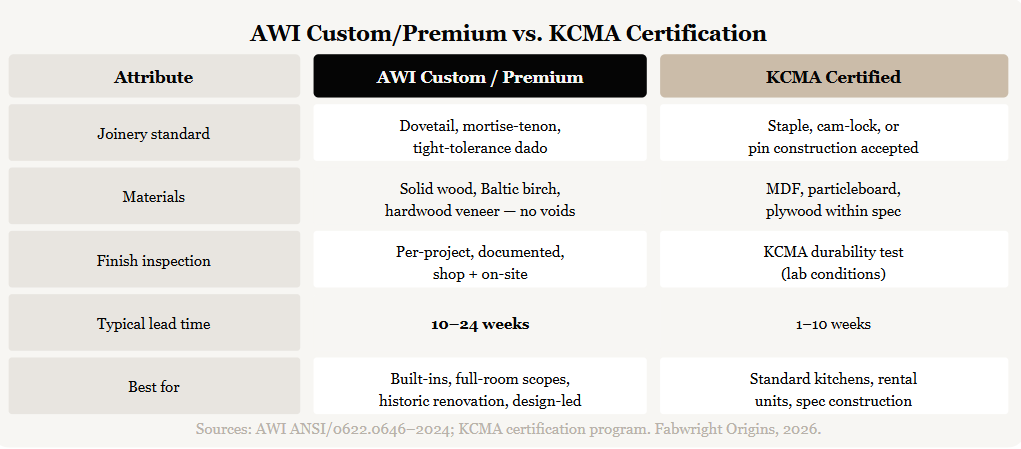
Attributes: Joinery, Materials, Finish inspection, Lead time, Best for — Sources: AWI, KCMA, 2024–2026
──────────────────────────────────────────────────────────────────────
When Is It Millwork, and When Is It Cabinetry? A Project-Type Guide
The clearest way to answer this is with a test: if removing the piece would leave a hole in the architecture — a gap in the wainscoting, a missing panel in the wall, an exposed soffit where the crown once ran — it’s millwork. If it could be taken out without structural consequence, it’s cabinetry.
Three questions help narrow it down further:
- Does fit matter more than speed? Custom millwork is built to the exact dimensions of your space. Semi-custom cabinetry is built to standard sizes and fitted afterward. If your ceiling is 9’4” and not square, or your wall has a window that breaks the run at an odd width, custom millwork is the answer. If you’re working in a new-construction box with plumb walls and standard heights, semi-custom may fit just fine.
- Is the woodwork integrating with the architecture or sitting in front of it? A kitchen base cabinet sits in front of a wall. A built-in library wall is part of the wall. Wainscoting, coffered ceilings, stair components, door and window surrounds — these are architectural elements. They don’t get removed; they define the room.
- What’s the project? Named project types map differently — see below.
Almost always architectural millwork: floor-to-ceiling library walls, full-room wainscoting, coffered ceilings, stair newels and balusters, mudroom locker built-ins with integrated trim, built-in window seats with paneling, butler’s pantry walls with integrated cabinetry and millwork details, historic reproduction profiles.
Can be either, depending on scope: kitchen base and upper cabinets, bathroom vanities, laundry room cabinets, home office storage.
Almost always millwork at Fabwright’s level: any project that requires scribing to an existing ceiling, matching period-accurate profiles, integrating storage into a wall paneling system, or spanning full room height with integrated crown.
The call comes in labeled “a simple pantry.” By the time we’re on-site measuring, it’s a full built-in pantry wall with fluted panels, integrated crown that has to match a 1910 profile in the adjacent dining room, and a sloped ceiling that requires every panel to be scribed down 3/8 of an inch. That’s not cabinetry by anyone’s definition. But the client used that word because they didn’t have a better one. We figure out the scope together, and then we give it the right name.
The practical distinction between millwork and cabinetry in residential projects comes down to three questions: whether custom fit matters more than speed, whether the piece integrates with or sits in front of the architecture, and what the specific project type is. Library walls, wainscoting, historic profiles, and built-ins that span full room height are almost always architectural millwork. Standard kitchen and bath runs can be either, depending on scope, ceiling height, and design intent.
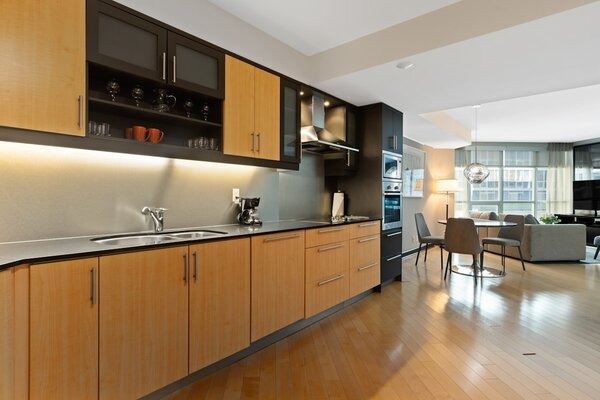
For a detailed look at how carpentry and millwork differ as trades — and why the distinction matters when you’re hiring — we’ve covered that separately.
──────────────────────────────────────────────────────────────────────
What Does the Difference Mean for Your Timeline and Budget?
Timeline is the most immediate practical difference between millwork and cabinetry. In 2025, according to the Houzz U.S. Kitchen Trends Study, the median major kitchen remodel spend was $60,000. In 2023, NKBA guidelines placed cabinetry at 29–35% of total kitchen remodel budgets (NKBA cost guidelines). That single line item is the most consequential decision in the project, and the range between stock and custom is enormous.
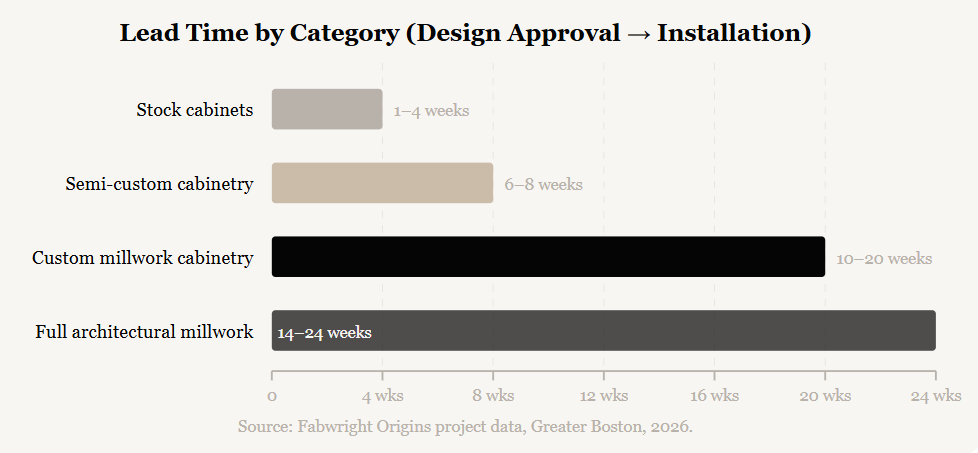
Here are the lead times from our own projects at Fabwright, from design finalization to installation complete:
- Stock cabinets (purchased and installed): 1–4 weeks
- Semi-custom cabinetry (order to install): 6–8 weeks
- Custom millwork cabinetry (design through installation): 10–20 weeks
- Full architectural millwork (trim, paneling, built-ins, stairs): 14–24 weeks
No competitor publishes actual Boston-area project timelines — these come from our own shop data, not national averages. Historic homes and projects requiring profile-matching to existing millwork consistently run toward the longer end.
Material grade. Solid hardwoods cost significantly more than MDF or particleboard. Figured lumber — quartersawn white oak, bookmatched walnut — carries further premium.
Fabrication approach. Production cabinetry is made in quantity on standardized tooling. Custom millwork is made individually to your specifications. Labor cost reflects that difference directly.
Installation conditions. A new-construction box with plumb, square walls is fast to install. A 1905 Brookline Colonial where nothing is square, where the ceiling has settled into a gentle curve, where the existing trim requires matching — that takes longer. Scribing every panel to the actual conditions of the room is time that shows up in the quote.
The ROI reality check. In 2025, the Zonda Cost vs. Value Report found that a major upscale kitchen remodel recoups 35.7% of its cost at resale nationally — while a minor cosmetic kitchen remodel recoups 112.9% (Zonda, Cost vs. Value Report 2025). Custom millwork is a long-term quality and design investment. It’s not primarily an ROI play, and any contractor who tells you otherwise is misleading you. You invest in custom millwork because you want woodwork that was designed for your space, built to last the life of the building, and looks like it was always there.
For a detailed breakdown of what custom work costs in Greater Boston, see our pricing guide for custom millwork in Greater Boston.
In 2025, the Houzz U.S. Kitchen Trends Study put the median major kitchen remodel at $60,000 (Houzz, 2025); in 2023, NKBA guidelines placed cabinetry at 29–35% of that total. Custom millwork cabinetry runs 10–20 weeks from design approval to installation — versus 1–4 weeks for stock cabinets. The gap in time and cost reflects fabrication standard, material grade, and fit precision.
──────────────────────────────────────────────────────────────────────
How Do Millwork and Cabinetry Work Together on a Real Project?
In most high-end residential projects, millwork and cabinetry aren’t separate purchases. They’re delivered by the same fabricator as a single integrated scope. A full kitchen renovation at Fabwright typically includes base and upper cabinetry, a range hood surround, open shelving above the refrigerator, a built-in pantry wall, and an island — all fabricated in the same shop, to the same material standard, with the same finish.
That integration matters for one reason above all: finish consistency.
[UNIQUE INSIGHT] Factory spray vs. shop-applied paint: color matches but sheen and texture don’t — visible at 7am under morning light. No competitor covers this.
Here’s where split scopes fail in practice. A general contractor buys semi-custom painted boxes from a cabinet dealer and hires a millworker to build the range hood surround, the open shelf wall, and the pantry units in painted poplar. The problem isn’t the millwork. The problem is the finish. Semi-custom painted cabinets use a factory spray process that reads differently under light than a shop-applied painted finish. The color matches — you checked it with a swatch. But the sheen and surface texture don’t. Nobody notices in the showroom. Everybody notices once it’s installed and the morning light hits it at 7am.
When does a split scope make sense? In renovation projects where the kitchen’s existing semi-custom boxes are in good shape and the scope is limited to adding a custom hood surround, open shelving, or a pantry wall, a split scope can work — particularly when the finish is specified clearly and both fabricators are using the same paint system. But that coordination has to be explicit, not assumed.
For how casework differs from both millwork and cabinetry — particularly relevant for commercial and institutional work — that distinction is covered separately.
In most high-end residential renovations, millwork and cabinetry are delivered as an integrated scope by a single fabricator — not split across vendors. When scopes are split (semi-custom boxes from one supplier, custom millwork from another), finish consistency is the first casualty. Factory spray finishes and shop-applied finishes read differently under natural light even when the color matches exactly. Integrated scope eliminates that risk by applying one finish standard across all wood surfaces in the space.

──────────────────────────────────────────────────────────────────────
What Should You Ask Before Hiring a Millwork Fabricator?
Whether your project is custom cabinetry or full architectural millwork, four questions reveal whether a fabricator can deliver what you’re envisioning.
- “Do you produce shop drawings before fabrication begins?” This is the single most telling question. Shop drawings — dimensioned drawings of every component, joint, and profile — are standard practice in architectural millwork. They’re how problems get caught before material is cut. A fabricator who skips shop drawings is improvising your scope in real time.
- “Are you KCMA-certified or do you build to AWI standards?” You don’t need to know every detail of either standard to ask the question. A fabricator who builds to AWI Custom grade will know exactly what you’re asking. The response tells you which industry they’re actually operating in.
- “Can I see completed work — installed in a real project, not just renderings?” Renderings show what was intended. Installed work shows what was actually built. Ask to see both the design drawing and the finished room.
- “What’s your lead time from shop drawing approval to delivery?” A fabricator who can’t give you a clear timeline hasn’t built enough projects to know their own capacity. A vague answer here usually means the actual timeline will be vague too.
At Fabwright, our first conversation is never about price. It’s about the space, the building, and what you’re trying to accomplish. If you’re weighing whether custom cabinets are worth it for your Boston home, that question deserves a more nuanced answer than a price-per-linear-foot quote.
For a deeper look at what millwork means in construction contexts — including how contractors and architects specify it — we’ve covered that separately.
The most revealing questions to ask a millwork or cabinetry fabricator: Do they produce shop drawings before cutting begins? Do they build to AWI standards or KCMA certification? Can they show installed work? What’s their realistic lead time? A fabricator who can answer all four clearly — without hedging — is operating at the level that custom work requires. One who deflects or substitutes renderings for real project photos represents significant risk.
Start Your Custom Millwork Project →
──────────────────────────────────────────────────────────────────────
Frequently Asked Questions About Millwork vs. Cabinetry
Is cabinetry considered millwork?
Yes. Custom cabinetry is a subset of millwork — fabricated to specification, typically to AWI quality grade standards. In 2025, semi-custom cabinets hold 46.39% of the global cabinet market (Mordor Intelligence, 2025), representing the factory-made middle of the spectrum. Custom cabinetry sits at the millwork end: built to your exact dimensions, materials, and finish specification.
What’s the difference between custom cabinetry and architectural millwork?
Custom cabinetry refers specifically to fabricated storage units — kitchen cabinets, bathroom vanities, built-in shelving. Architectural millwork is the broader category: it includes custom cabinetry but also trim, molding, wall paneling, stair components, coffered ceilings, and structural-decorative elements designed to integrate with a building’s architecture. See our full guide to what architectural millwork is and how it’s built for the complete breakdown.
Which is more expensive, millwork or cabinetry?
Custom millwork costs more than semi-custom or stock cabinetry because it’s fabricated to specification, uses higher-grade materials, and requires on-site scribing and installation. In 2025, the median major kitchen remodel was $60,000 (Houzz, 2025), with cabinetry representing 29–35% of that budget. In Greater Boston, custom millwork cabinetry projects start at $15,000; full architectural millwork scopes run significantly higher.
How long does custom millwork take compared to stock cabinets?
Stock cabinets are purchased and installed in 1–4 weeks. Semi-custom: 6–8 weeks. Custom millwork cabinetry (design through installation): 10–20 weeks. Full architectural millwork including trim, paneling, and built-ins: 14–24 weeks. These are Fabwright’s actual project timelines from Greater Boston work — not national averages. Historic homes and profile-matching projects run toward the longer end.
What are AWI and KCMA certifications, and which applies to my project?
AWI (Architectural Woodwork Institute) defines quality grades for custom and architectural-grade woodwork: Economy, Custom, and Premium. The ANSI/AWI 0622.0646–2024 standard, effective November 15, 2024, governs fabrication of millwork and shop-made assemblies (AWI, IWF Atlanta, 2024). KCMA (Kitchen Cabinet Manufacturers Association) certifies factory-produced cabinetry for structural and finish durability. Custom millwork: AWI standards. Stock or semi-custom cabinets: KCMA certification.
Can one contractor handle both cabinetry and architectural millwork?
Yes — and for most high-end residential projects, that’s the recommended approach. A fabricator who handles both ensures a consistent material standard, matched finishes across all wood surfaces, and a single installation team. Splitting the scope between a cabinet supplier and a millwork shop is possible, but finish consistency requires explicit coordination and matching paint systems — a risk that an integrated scope eliminates entirely.
──────────────────────────────────────────────────────────────────────
Two Terms, One Decision
Millwork and cabinetry aren’t opposites. They’re the same craft family at different points on the production spectrum. Custom cabinetry is millwork. Stock cabinetry is factory production. The question is which end of the spectrum your project calls for — and most high-end residential projects call for both, delivered as one integrated scope.
- Custom millwork = AWI standards, built to specification, 10–20 week lead time
- Production cabinetry = KCMA certification, standard sizes, faster lead times
- Most design-forward residential projects blend both, under one fabricator’s scope
In Greater Boston, that scope usually involves historic buildings, specific neighborhood architectural vocabularies, and millwork that has to hold up to comparison with original work that’s been in the building for a hundred years. That’s the work we do.
If you’re trying to figure out which applies to your project — or if you’re ready to start talking about it — start with how we define millwork or bring your project directly to the shop.
Bring Your Vision to the Shop →
──────────────────────────────────────────────────────────────────────
About the author: Jemuel Stephenson is the founder of Fabwright Origins, an architectural millwork and custom cabinetry fabricator located at 13 Humphreys St, Boston, MA 02125. An MIT-trained engineer and master millworker, Jemuel builds work for residential homeowners, interior designers, architects, and commercial clients across Boston, Brookline, Cambridge, Wellesley, Newton, Lexington, and communities throughout the South Shore. Fabwright Origins is a proud member of the Ujima Good Business Alliance (UGBA) and a Black-owned business. Call 617-506-9293.
──────────────────────────────────────────────────────────────────────
Sources
- Mordor Intelligence, Global Cabinet Market Report, retrieved 2026-05-27, https://www.mordorintelligence.com/industry-reports/cabinet-market
- AWI / IWF Atlanta, The New AWI Standards and ANSI: What It Means for Millwork, retrieved 2026-05-27, https://www.iwfatlanta.com/exhibitors/the-new-awi-standards-and-ansi-what-it-means-for-millwork/
- Houzz, 2025 U.S. Houzz Kitchen Trends Study, retrieved 2026-05-27, https://www.houzz.com/magazine/2025-u-s-houzz-kitchen-trends-study-stsetivw-vs~179685414
- KBE Build / NKBA, Kitchen Remodel Cost Breakdown, retrieved 2026-05-27, https://www.kbebuild.com/2023/03/09/kitchen-remodel-cost-breakdown/
- Zonda, Cost vs. Value Report, 2025 Edition — Journal of Light Construction, retrieved 2026-05-27, https://www.jlconline.com/cost-vs-value/2025/
- P&S Market Research, U.S. Millwork Market Size and Growth Report, retrieved 2026-05-27, https://www.psmarketresearch.com/market-analysis/us-millwork-market-report