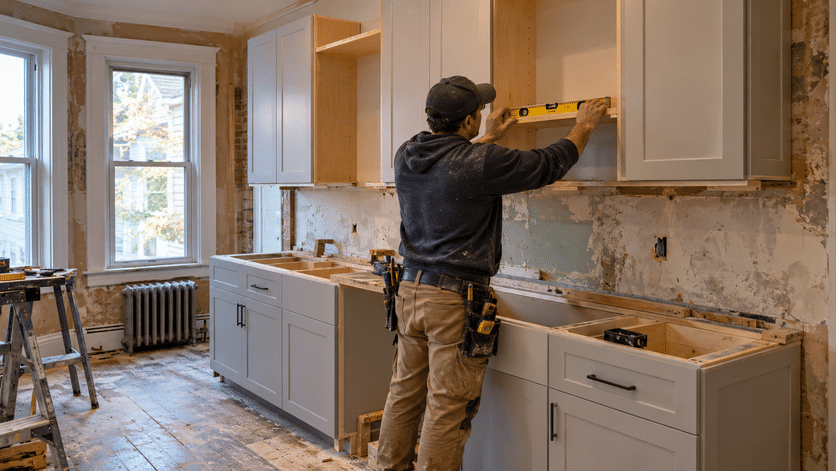
Every serious millwork project starts with two questions: what will it cost, and how long will it take? The 2025 Houzz Kitchen Trends Study, which surveyed 1,620 U.S. homeowners, found that most major kitchen remodels run 10 to 17 weeks from demolition to final inspection (Houzz, 2025 Kitchen Trends Study). Custom cabinetry and architectural millwork sit at the longer end of that range, because each piece is engineered and built for one room. Here is the honest, phase-by-phase timeline we walk Boston clients through.
Key Takeaways
- Most full custom cabinetry and millwork projects run 12 to 24 weeks end to end, from first consultation to final installation.
- Custom cabinet lead times alone range from 8 weeks to 6 months (This Old House), with fabrication the longest single phase.
- Finish choice, material lead times, project scope, and busy season are the four factors that move a timeline the most.
- Booking your shop slot early—before final drawings are done—is the single best way to protect your schedule.
How long does a custom cabinetry and millwork project take?
A full custom project typically takes 12 to 24 weeks from your first consultation to the last cabinet door being hung. Custom cabinet lead times on their own range from eight weeks to six months (This Old House), and the spread comes down to design complexity, finish, and how booked the shop is when you sign.
That range surprises people who expect a few weeks. The reason is simple: nothing is pulled off a shelf. We design it, engineer it, build it, finish it, and install it—five distinct phases, each with its own clock. Stock and semi-custom lines move faster, but they cannot match a piece built to your exact dimensions, species, and detailing.
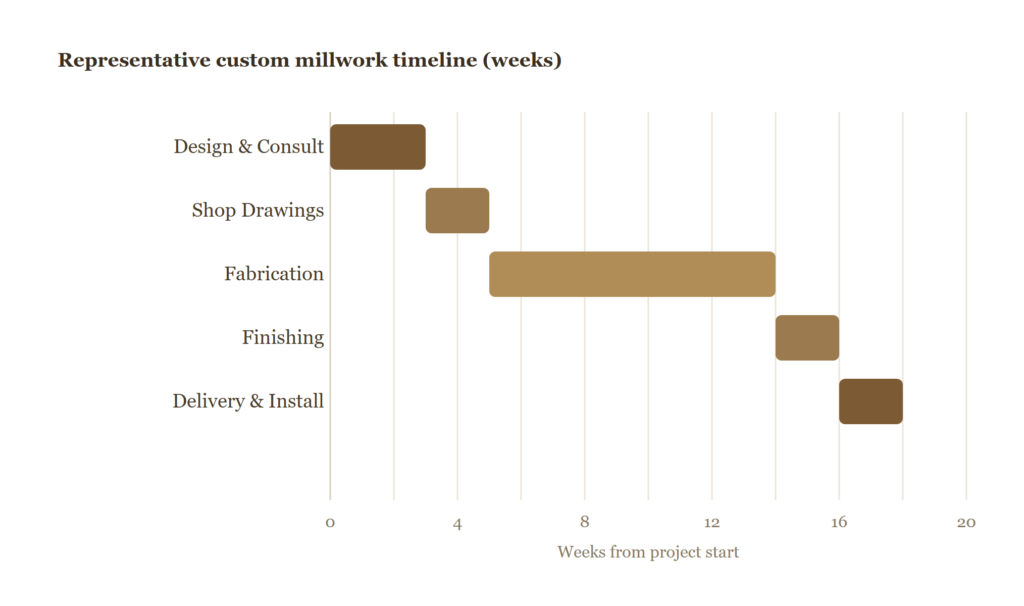
The chart below shows a representative timeline for a mid-sized residential project. Yours may compress or stretch, but the sequence rarely changes.
Want the cost side of the equation too? Our guide to custom millwork costs breaks down pricing the same way we break down time here.
What are the five phases of a custom millwork timeline?
Custom millwork moves through five phases: design and consultation, engineering and shop drawings, fabrication, finishing, and delivery and installation. Fabrication is the longest, often eight to twelve weeks on its own, which is why custom work outpaces stock cabinetry on the calendar.
1. Design & consultation (2–4 weeks)
This is where we listen, measure, and translate your vision into a buildable concept. We review the space, talk through species and style, and confirm budget. The more decisions you settle here, the smoother every later phase runs. Indecision on finish or layout is the most common reason this phase stretches.
2. Engineering & shop drawings (1–2 weeks)
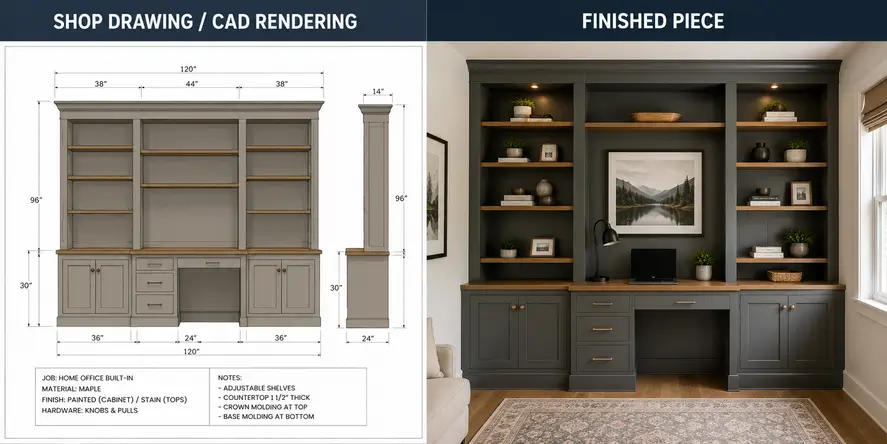
Every piece is engineered before a single board is cut. Using tools like Microvellum and Cabinet Vision, we produce precise shop drawings that turn the design into exact cut lists and joinery. You approve these drawings, and that approval locks the build. Changes after this point are where most delays come from.
3. Fabrication (6–12 weeks)
Now the shop goes to work—milling, joinery, assembly, and dry-fitting. This is the longest phase because it is the real craft: solid wood and veneers cut, shaped, and assembled to tolerances stock cabinets never see. Specialty materials and intricate detailing add time here more than anywhere else.
4. Finishing (1–2 weeks)
Staining, painting, and clear-coating happen in controlled conditions, and finish is where patience pays. Painted and lacquered finishes need extra curing time compared with stains, so a high-gloss painted kitchen will sit longer than a clear-coated walnut one. Rushing the finish is the fastest way to ruin good work.
5. Delivery & installation (1–2 weeks)
Finished millwork is delivered and installed on site, scribed to walls that are never perfectly square—especially in older Boston homes. Installation is quick relative to fabrication, but it demands the same precision. A clean install is what makes custom work look like it was always part of the house.
Why do custom millwork timelines vary so much?
Timelines vary because four factors stack on top of the base schedule: finish type, material lead times, project scope, and the season you book. This Old House puts custom cabinet lead times anywhere from eight weeks to six months (This Old House)—and that six-month end is almost always one of these four factors at work.
Think of these as add-ons to the base timeline rather than replacements for it. A painted whole-home package booked in May can easily run months longer than a single stained built-in booked in January. The chart below shows roughly how much time each factor tends to add.
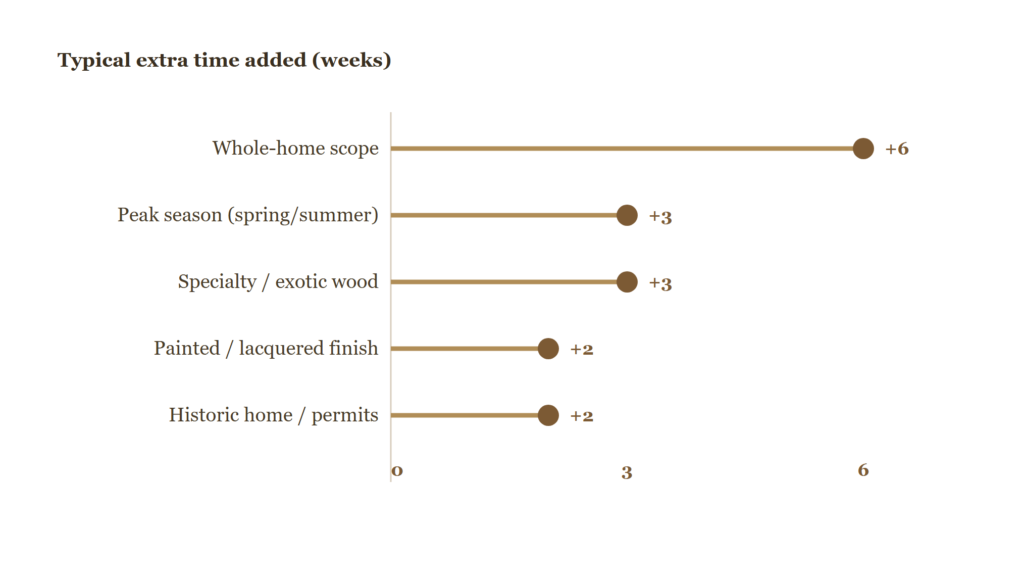
Older homes deserve special mention. Our work in Boston’s historic and brownstone homes almost always involves out-of-square walls and approvals that a new build never faces.
How do residential and commercial millwork timelines compare?
Commercial millwork often carries a longer timeline than residential work of the same size, because it adds layers of approvals, submittals, and coordination with general contractors and architects. A single home built-in can be designed and built in weeks; a lobby or retail buildout is paced by the construction schedule around it.
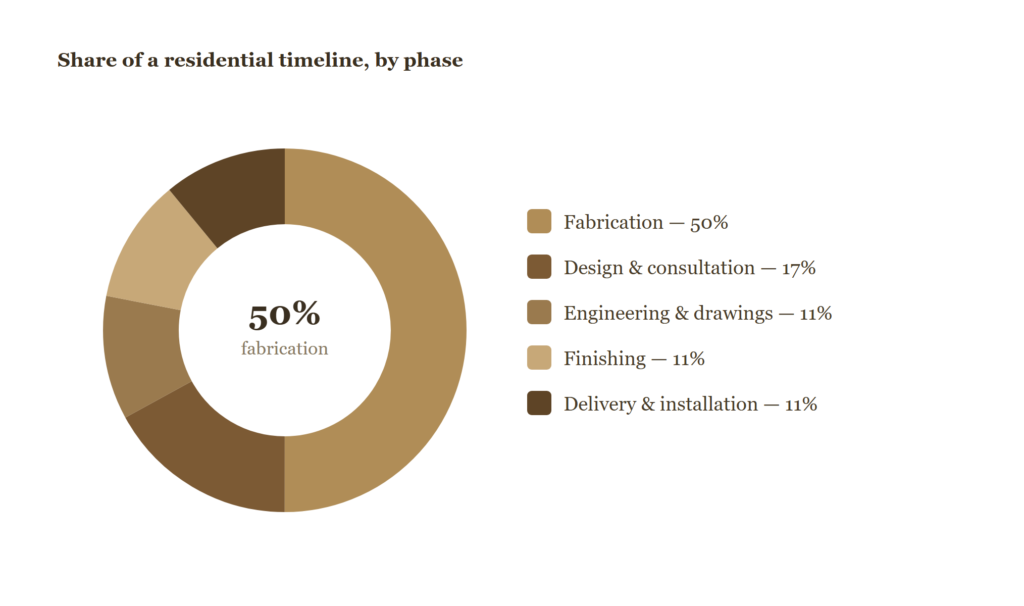
The proportions also shift. On residential projects, fabrication dominates the calendar. On commercial jobs, the design, submittal, and approval cycle expands while the shop waits for sign-off. The donut below shows how a typical residential timeline breaks down by phase.
If you are weighing a larger fit-out, our full range of millwork services covers both residential and commercial scopes, each scheduled to the realities of its site.
How can you keep your millwork project on schedule?
The most reliable way to protect a timeline is to lock decisions early and book your fabrication slot before final drawings are complete. Because fabrication is the longest phase, a held shop slot is worth more to your calendar than almost anything else you can do. Late changes, by contrast, ripple through every phase that follows.
A few habits keep projects moving:
- Decide finishes early. Finish choice affects both fabrication and curing time—settle it before drawings are approved.
- Approve shop drawings promptly. The build cannot start until you sign off. A week of indecision here is a week added to the end.
- Avoid mid-build changes. Once material is cut to your drawings, changes mean re-engineering and re-cutting.
- Book ahead of peak season. Spring and summer fill shop calendars fastest; a winter signing often beats a summer one to the finish line.
- Choose an experienced maker. A shop that engineers properly the first time avoids the rework that quietly doubles timelines.
Not sure how to vet a shop on schedule reliability? Our guide on how to choose a custom cabinet maker in Boston includes the exact questions to ask about lead times before you sign.
Planning a project? Let’s map your timeline. Tell us your space, style, and target completion date, and we’ll give you an honest, phase-by-phase schedule for your custom cabinetry or millwork—before you commit. Request your free design-build consultation →
Frequently Asked Questions
How long do custom cabinets take to make?
Custom cabinets typically take 8 to 12 weeks to fabricate, and lead times can stretch from 8 weeks to 6 months depending on finish, materials, and shop demand (This Old House). Fabrication is the longest single phase of any custom cabinetry project.
Why does custom cabinetry take longer than stock cabinets?
Custom cabinetry is engineered and built for one specific space, so nothing is pulled from inventory. The 2025 Houzz study found major kitchen remodels run 10 to 17 weeks overall (Houzz, 2025), and custom work sits at the longer end because every piece is made to order.
What part of a millwork project takes the longest?
Fabrication takes the longest—commonly 6 to 12 weeks—because milling, joinery, assembly, and dry-fitting are done by hand to exact tolerances. It usually accounts for about half of a residential project’s total timeline, far more than design, finishing, or installation.
Does a painted finish take longer than a stained one?
Yes. Painted and lacquered finishes require additional curing time in controlled conditions, typically adding a week or two compared with stained finishes. If your schedule is tight, a stained or clear-coated wood finish will usually reach installation faster than a high-gloss painted one.
How far in advance should I book a custom millwork project?
Book as early as possible—ideally before final drawings are complete—so your fabrication slot is held. Spring and summer fill shop calendars fastest, so a winter or early-spring signing often beats a summer one to completion even on identical projects. Are custom cabinets worth the wait? Our homeowner’s guide makes the case.
Plan with a realistic timeline, not a hopeful one
Custom cabinetry and millwork reward patience. Twelve to twenty-four weeks sounds long until you see the difference between built-to-fit craftsmanship and something pulled off a shelf. The homeowners happiest with their results are the ones who planned around the real schedule from day one.
If you know your finish, hold your shop slot, and approve drawings on time, your project will track close to the timeline above. From kitchens to whole-home custom kitchen cabinetry and architectural millwork, Fabwright Origins builds for Greater Boston homes, designers, and developers who want it done right the first time. Browse our finished projects to see the results.
Sources
- Houzz, 2025 U.S. Kitchen Trends Study, retrieved 2026-06-30 — https://www.houzz.com/magazine/2025-u-s-houzz-kitchen-trends-study-stsetivw-vs~179685414
- This Old House, All About Kitchen Cabinets, retrieved 2026-06-30 — https://www.thisoldhouse.com/kitchens/all-about-cabinets
Written by Jemuel Stephenson, founder of Fabwright Origins.