A well-built closet is one of the few upgrades that pays you back almost in full. Per the 2025 Remodeling Impact Report from the National Association of REALTORS, a closet renovation recovers about 83% of its cost at resale—one of the highest returns in the home (NAR, 2025). Here is how a Boston millworker approaches custom closets and walk-in wardrobes.
Key Takeaways
- A custom closet renovation recoups roughly 83% of its cost at resale (NAR, 2025 Remodeling Impact Report).
- Walk-in closets typically run $2,500–$7,500; reach-ins $1,200–$2,500; dressing rooms can reach $20,000.
- Custom (furniture-grade) closets differ from modular kits in materials, joinery, and fit.
- Good closet design starts with zones—hanging, folded, and shoes—not shelves.
What is a custom closet, and how is it different from modular?
A custom closet is built for one specific space and owner, with furniture-grade materials and joinery, rather than assembled from a catalog of standard parts. Modular and wire systems are quicker and cheaper, but they can’t match a custom build’s fit, finish, or details—dovetailed drawers, integrated lighting, and cabinetry that reads like part of the room.
The difference shows most in a primary suite, where the closet is visible from the bedroom. A custom wardrobe wall or island unit continues the millwork language of the home; a wire rack announces itself as storage. If you already value custom cabinetry and built-ins, a custom closet is the same craft applied to how you dress.
How much does a custom closet cost?
Custom closets generally cost $1,200 to $2,500 for a reach-in, $2,500 to $7,500 for a walk-in, and $8,000 to $20,000 for a high-end dressing room (Angi, 2025). Priced by the linear foot, most systems run $150 to $450 depending on materials and features.
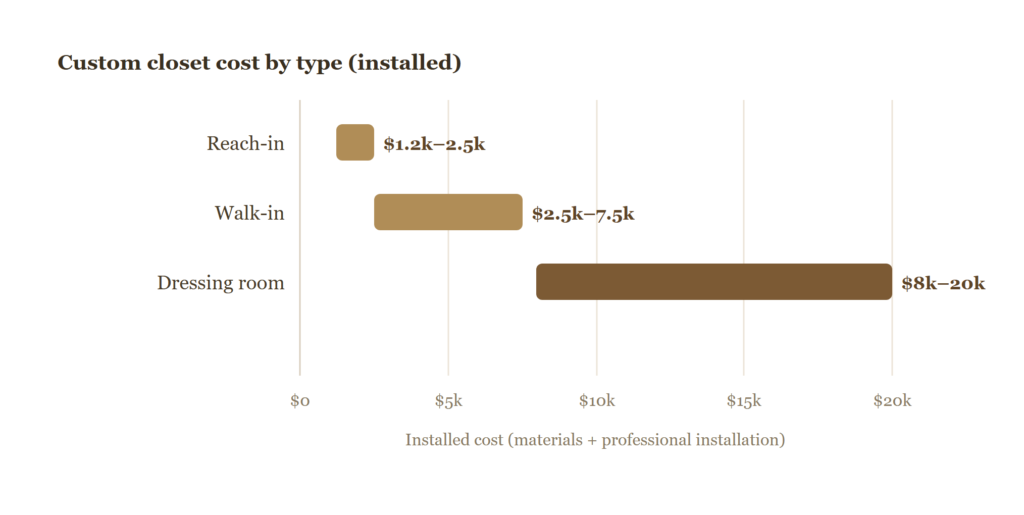
What moves the number: solid-wood vs. panel construction, drawer count and joinery, integrated lighting, islands, and specialty storage. For how a closet fits a broader project budget, see our custom millwork cost guide.
Do custom closets add resale value?
Yes—closets are among the best-returning projects in the house. The 2025 Remodeling Impact Report puts closet-renovation cost recovery at about 83%, ahead of many kitchen and bath projects (NAR & NARI, 2025). In a primary suite, a well-designed wardrobe is often what buyers remember.
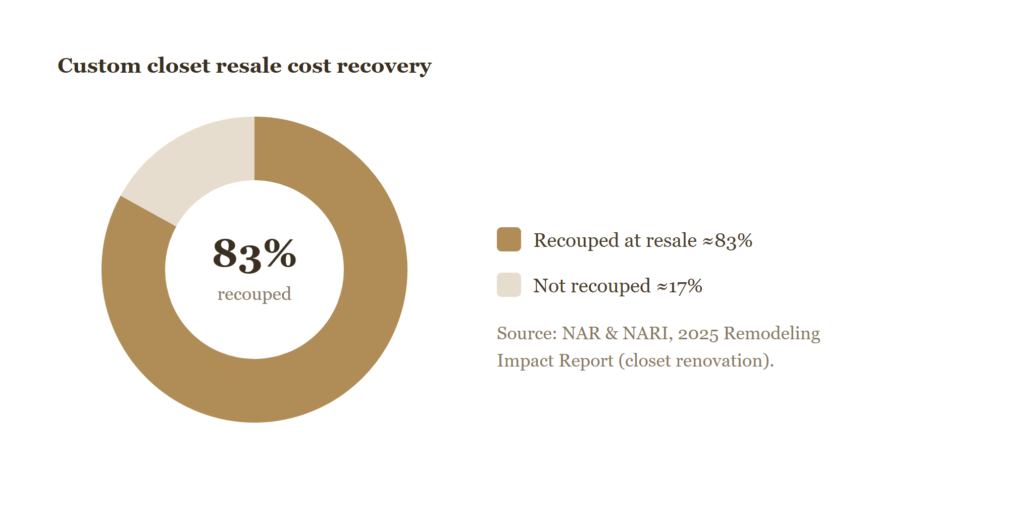
Beyond the resale figure, the daily return is real: a closet that fits your wardrobe saves time every morning. The value is both financial and lived-in.
How do you design a walk-in closet that works?
Great closets start with zones, not shelves—map hanging, folded, and specialty storage to your actual wardrobe before drawing a single shelf. Get the proportions right and everything has a home; skip this step and you end up with pretty storage that doesn’t fit your life.
Plan your hanging math
Double-hang sections (two rods stacked) roughly double capacity for shirts and folded-length items; reserve long-hang for dresses and coats. Most wardrobes need far more double-hang than people expect.
Add drawers and an island
Dovetailed drawers handle folded items and accessories better than shelves. In larger walk-ins, an island adds drawer storage plus a folding surface and a place to sit.
Get the lighting and mirrors right
Layered lighting—perimeter plus task lighting in the island—makes colors read true. Place a full-length mirror where you naturally check an outfit, ideally near natural light.
What materials and finishes hold up best?
The most durable custom closets use plywood cabinet boxes, solid-wood or furniture-grade fronts, and dovetailed drawers—the same construction as fine cabinetry. Painted finishes suit bright, dressing-room looks; natural wood brings warmth and hides wear.
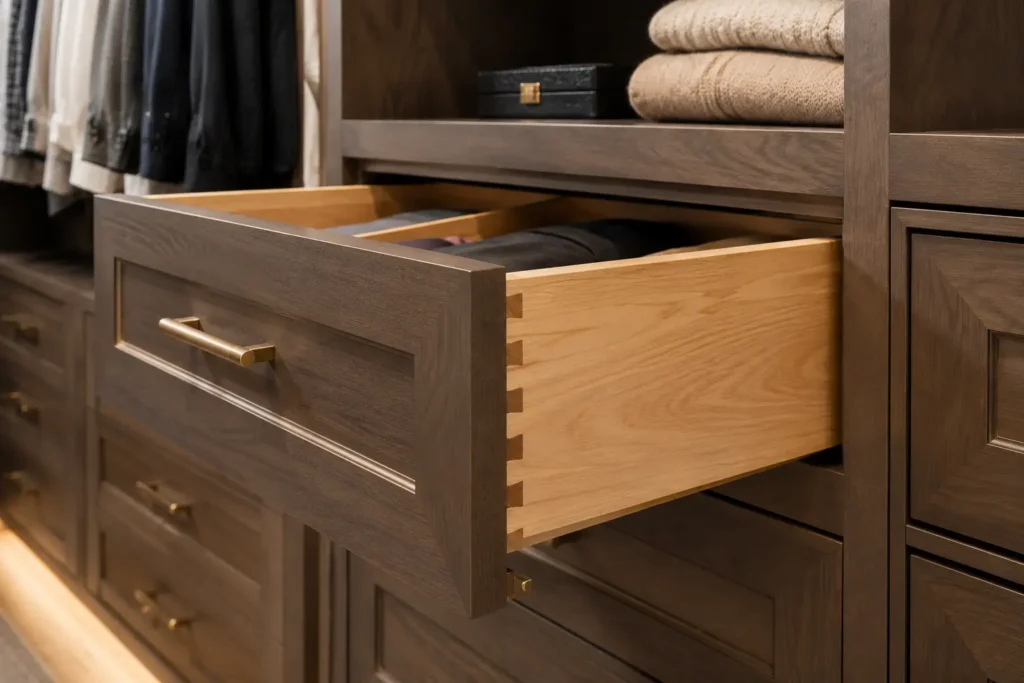
Species matters here just as it does in the kitchen—grain, hardness, and how a wood takes finish all factor in. Our guide to the best wood species for custom cabinetry applies directly to wardrobe millwork, and the same standards run through our residential millwork services.
Ready to design your closet? Tell us your space and your wardrobe, and we’ll design a custom closet or walk-in wardrobe built to fit how you actually live—furniture-grade, down to the last drawer. Request your free design-build consultation →
Frequently Asked Questions
How much does a custom closet cost?
Custom closets run about $1,200 to $2,500 for a reach-in and $2,500 to $7,500 for a walk-in, while high-end dressing rooms can reach $20,000 (Angi, 2025). By the linear foot, most systems cost $150 to $450 depending on materials and features.
Do custom closets add value to a home?
Yes. The 2025 Remodeling Impact Report puts closet-renovation cost recovery at about 83%, among the highest of any project (NAR & NARI, 2025). A well-designed wardrobe in a primary suite is often a strong selling point.
What is the difference between a walk-in and a reach-in closet?
A walk-in is a room you enter, allowing hanging on multiple walls, an island, and seating; a reach-in is a shallow closet accessed from one open face. Walk-ins cost more but offer far more design flexibility and storage per square foot.
What material is best for a custom closet?
Furniture-grade plywood boxes with solid-wood or painted fronts and dovetailed drawers last longest and look best. Wire and melamine kits cost less but can’t match the fit, finish, or durability of custom millwork.
How long does a custom closet take to build?
Most custom closets take a few weeks from design approval to installation, depending on materials, finish, and shop schedule. Painted and specialty finishes add time, as does a larger dressing-room build with islands and integrated lighting.
A closet worth waking up to
Custom closets earn their place twice—about 83% back at resale, and a smoother start to every day in between. The difference is design that starts from your wardrobe and construction that matches fine cabinetry.
From reach-ins to full dressing rooms, Fabwright Origins designs and builds custom closets and wardrobe millwork for Greater Boston homes. Browse our finished projects to see the craft, or explore our kitchen cabinetry to see the same standards applied elsewhere in the home.
Sources
- National Association of REALTORS & NARI, 2025 Remodeling Impact Report, retrieved 2026-08-04 — https://www.nar.realtor/newsroom/top-remodeling-projects-for-homeowner-satisfaction-and-cost-recovery-revealed-in-nar-report
- Angi, How Much Do Custom Closets Cost?, retrieved 2026-08-04 — https://www.angi.com/articles/how-much-do-custom-closets-cost.htm
Written by Jemuel Stephenson, founder of Fabwright Origins.